Friday, November 10, 2023

Speak Up

I would have liked to have written something funny today. I have a funny story to tell, about how I went to yoga with a face towel I'd clearly previously used to condition tack--it was clean, but it still smelled like Lexol--and how every time I wiped the sweat from my face my face got more and more shiny and conditioned until by the end of class it was as sleek and shiny as my saddle. But then after class I looked at my phone, and read about another hate crime, this time a Jewish man in Australia being attacked in a public park, and it didn't feel like time to be funny.

There's been a steep increase in the number of antisemitic events world-wide, especially since the terror attacks in Israel October 7th, but over the last several years as well. 

I'm not Jewish, though I once read on the internet that I was. I can't offer a profound opinion on the current Israeli-Palestinian war or the decades of conflict that preceded it. I don't understand the history or politics well enough. I can say that terrorist attacks are wrong. I don't like bombing refugee camps, nor do I like the idea of refugees being used as human shields by their countrymen. I hate that children are dying.

I love my Jewish friends. I've spoken to a few of them and emailed a few more. My heart is especially with one of my college classmates, who lives in Israel and whose oldest child is currently doing mandatory service in the Israeli army. I pray for that young person every day.

But more than loving my Jewish friends--how hard is that, Jesus even talks about it, scathingly--If you love those who love you, what credit is that to you? Even sinners love those who love them.  And if you do good to those who are good to you, what credit is that to you? Even sinners do that"--I support their civil rights. I support their right to exist peacefully in a global society--and honestly, I think everyone who considers themself a good person had better start doing that, because the last time we allowed antisemitism to rage unchecked we ended up in a horrible world war. 

Next week I'm speaking at a Catholic middle school. Yesterday I sat down to tweak my slide presentation--I've got a new book coming out in April, and, for the first time, I'm talking about it. The Night War is the story of a young girl named Miri, who escapes the massive round-up of Jews in Paris and finds herself in the village of Chenonceaux, where Catherine de Medici's ancient castle is being used to smuggle people to the relative safety of Vichy France. 

Miri is fictional, but the historic background is true. I made a slide about the Pletzl, the Jewish immigrant quarter in Paris. I put in one showing the only known photo of the Vel D'Hiv roundup, and added another of Chenonceau, the beautiful chateau. 

Then I added a slide to illustrate the Nazi's antisemitism. Here's the image:
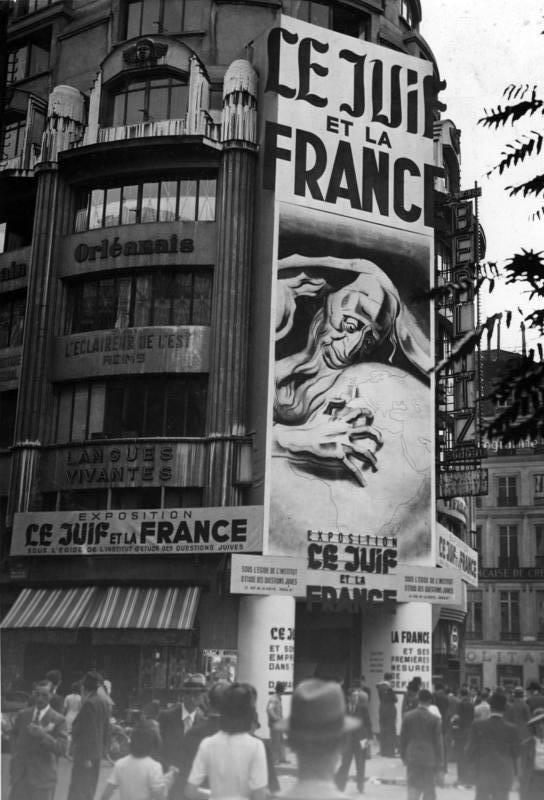
It was an exhibition the Nazis brought to Occupied Paris--"The Jew and France." You can see the stereotyped hooked nose and grasping fingers--all the old tropes repeated.  

My search for my next slide sent me down a particularly loathsome rabbit hole. I'm not going to reprint the image I chose, though I will share it with the students I talk to. It features the same type of hooked-nose grasping cartoon figure, and then it accuses Jews of a surprising number of things, including feminism and hate crime laws--good job, Jews! Where do we thank you?--also climate change, communism, the lack of a wall on our Mexican border, and everyone's old favorite, usury. You know why Jews are accused of usury, which is the charging of too much interest? It dates back to the middle ages, when Catholics were forbidden by the Pope to charge any interest at all on loans. This meant that Catholics, which were the only type of Christian we had back then, couldn't be bankers, or at least not successful ones. At the same time, most countries had laws saying Jews couldn't own land or be in craft guilds. So--Jews became bankers. And then, if you're rich and powerful, and you've borrowed a bunch of money and don't want to pay it back---right, make it the bankers' fault. You can, because the bankers are all from a group of people who've already been stripped of many of their rights. See how this works? It's power and racism, same as now.

I'm looking forward to talking about antisemitism at this school next week, not because it will be fun, but because I'll be doing something I know is right. (Pro tip: if you're conflicted on which side is right, pick the side opposite the Nazis.) I know it's important, and I know it needs to be done.

Speak up. Yes, you. Speak UP. Otherwise the bad guys win.

Tuesday, August 8, 2023

Bon-bons on the Couch Vs. Trying

Last Friday I woke up with a heavy knot of anxiety in my stomach. My daughter and I had entered a horse trial for the weekend, and I'd reached the point where it seemed like a Very Bad Idea. I emailed a friend that I wasn't sure why I was competing, at this point in my life. It would be much simpler and probably much more pleasant to eat bon-bons on the couch all day instead. I then trudged out to the barn and explained to my daughter how I felt. "Ah," she replied, with genuine sympathy. "I've been there." Then she set up a beginner-novice oxer to vertical two-stride and told me to get myself and my mare over it.

I'm condensing a bit. And I'd like to say that beginner-novice used to be the lowest commonly-offered level of my chosen sport, eventing. Recently most events have added an even lower level, called Starter, which is where my mare and I are. Starter jumps are essentially speed bumps. I once competed several levels higher, schooled above that, and had serious plans to compete at a level that's tough by nearly anyone's standards. But then I landed on my head one too many times (four too many times...) and then I spent five years with undiagnosed autonomic dystonia, which meant that my entire autonomic nervous system--the bits you don't consciously control, like heartrate and blood pressure--spiraled out of control any time I was moving through space quickly, say, on the back of a cantering or even trotting horse. My heart rate would go above 170 bpm--no, that's not safe at my age--and my asthma would get bad, and not surprisingly I would feel pretty anxious, and the worst part was that no amount of effort in the world, no slow careful fitness work, no asthma meds, no EMDR (which I otherwise love) or thoughtful mental exercises, or brilliant kind horses or good coaching or anything else I tried would make it better. I couldn't get fit, because the exercise needed to improve my fitness was on the other side of the dystonia wall. I didn't understand what was happening to me, and I couldn't make it better, even though I really, really tried.

Then for a bit I traveled a ton for my writing, then we had a global pandemic, then my good mare Sarah was injured in the field to the point where she had to be retired, then the wonderful horse I leased went back to his owners, then my trainer found me a new, lovely, sensible, short-and-wide little mare. Rosie hadn't done much but she is cheerful and tries hard. Oddly enough, owning her didn't cure my brain dysfunction, so for our first year, stuck with a rider who had actual micro-blackouts from time to time, limited balance, and a perpetually racing heartbeat, Rosie got rather less brave in self-defense.

Then, finally, I got a diagnosis, and treatment from a functional neurologist. I don't really understand it all but I can say it's empirically much better, and I've been slowly making real progress at last. Last week my daughter and I did conditioning with our horses on the long slow hill on our farm, something we've done for years. Walk up, walk down. Trot up, walk down. Canter up, walk down. I've got an exercise app on my Apple watch--which is how I finally realized my heartrate was so out of control in the first place--and last week, for the first time, when I trotted Rosie up the hill with myself in two-point--a bit like a jockey--then cantered up it in the same position (so, my own effort was the same, but my body was moving more quickly though space) my heartrate stayed the same. And was also reasonable.

This is huge, and exciting, and I've been gradually, systematically restoring Rosie's confidence, and my own. And yet--why compete? Especially last weekend, when I had nothing on the line, knew that I won't make it to any other horse trials this year, wasn't qualifying for anything, etc., etc., and let's face it, I'm not headed for the Olympics or anything--the importance of this show from an external standpoint was zero. 

Also it was so much work, and it was very hot, and that two-stride my daughter set looked really scary, both to me and to Rosie. "Will they have a two-stride on Starter?" I asked. The answer was Almost Certainly Not. I'd ridden Starter at this venue before, with the leased horse, and the showjumping course was outside-diagonal-outside-diagonal, the simplest 8-jump course in the world. 

My daughter set me a whole course, with the two-stride at the end. And I can canter whole courses now, which I couldn't do for a long time (before this, we trotted them). And Rosie did the whole course beautifully until the two-stride, where she spun away the second element, afraid. "Do I lower it?" my daughter asked.

"No," I said, "For heaven's sakes. She can trot that." (I probably said a different word than "heaven's.") I had her jump the second element by itself, twice, then the whole two-stride twice, and then I pulled her up and patted her. "Now I repeat the whole course?" I asked.

My daughter shrugged. "Maybe just the second half."

"Cathy," I said, referencing our coach and good friend, the indomitable Cathy Wieschhoff, "would make me repeat the whole thing."

So I did, and we were awesome. The anxious feeling in the pit of my stomach slid away. And then it stayed gone while I went to the event and competed at wiener Starter, and Rosie was very good in dressage, and then there actually was a two-stride on the Starter showjump course, and Rosie turned to it with understanding and something like pleasure, and jumped it very neatly. And we cantered the whole course and my heart rate stayed manageable, and my asthma didn't spike, and I didn't feel dizzy, and I rode well. The way I used to. The way I've longed to.

The next day Rosie warmed up for cross-country beautifully. We cantered the first fence on course and I felt her falter a tiny bit--wow, Mom, that came up fast--my old horse Gully always liked time to process situations he didn't really understand, and Rosie's the same way. She goggled at the big fences to either side of our small second fence, and I could tell the entire undertaking felt like a lot to her. We haven't schooled off our home farm since April, and while she wasn't at all worried about the jumps I was asking of her, she was concerned about the upper-level jumps nearby and the jump judges and being alone on course and who knows what else. She spun a few times, looking for a more comfortable place to be, and I turned her back the way we needed to go, with some correction but not too much fuss. We jumped all our jumps on the first attempt. We trotted more of the course than I had planned but I gave her the ride she needed.

Then we had a whole snafoozle at the finish line--a long story, fault on both sides--and ended up with time faults and didn't get a ribbon, but of course Rosie didn't know that, she felt very happy, and I didn't care--what's a ribbon, really?--and I felt very happy, and also physically really good, in a way I haven't for a long, long time. And we'll spend the fall and winter, in between weddings and trips and lovely family things, schooling some more off-property and getting Rosie used to more things, just as we got her used to the two-stride. And we'll compete not because we're headed for the Olympics or even for low-level glory, but because accomplishing something that both takes effort and makes your heart sing is always worthwhile. It even beats bon-bons on a nice comfy couch. The journey is its own reward.


Tuesday, August 1, 2023

A Free Ice Cream Kind of Day

 Well. Yesterday the ALI Team (want to join us? we have work for you!) got to tour what used to be a medical laundry facility, but what will be soon, once we've signed a few papers, the NEW WORLD HEADQUARTERS OF APPALACHIAN LITERACY INITIATIVE. It's so amazing I can't even think about it in less than ALL CAPS. 

Bristol Faith in Action has been astonishingly generous, giving us space for the last 3 years, but last year we just barely squeezed into it, and BFIA didn't have more to give. I will be thankful to them forever, and it was time for us to go.

The Team had a list of hopes for a new space: bigger, preferably big enough we could stay there for a good long while; free (oh we desperately hoped for free!); was climate-controlled (books need this, to say nothing of our Board and volunteers); had a functioning toilet; had WIFI or could have it added. Then we had a list of wouldn't-it-be-wonderful but not required, like a room or two separated off from the rest, and being within pleasant driving distance for most of us. In our pipe dreams we wanted a loading dock where it would be simple to unload pallets of books from the trucks delivering them (40,000 books is a lot to load and unload), and if we could have everything we wanted we'd prefer the space be in Tennessee.

Bristol is a border city, smack dab on top of the Tennessee/Virginia state line, which in our downtown actually forms the main street. This creates all sorts of unusual situations--right now, for example, the Tennessee grocery stores are on a sales tax holiday while the Virginia stores that are part of the same chain are not. ALI is based in Tennessee, it's where our legal address (a PO Box) and our registration are, but BFIA, where we had books delivered, is in Virginia. In Tennessee, to get a sales tax exemption certificate, which we are required by law to give to all the people we buy books from so we can get them tax-free, you type your Federal Nonprofit ID number into a database, and you get a certificate good for five years. It may have cost $20 originally, I can't remember, but I know that when it ran out a few weeks ago another appeared like magic in my PO Box, good for another five years.

In Virginia, to get the same certificate, I first had to register for some sort of state tax number, and getting it took a few weeks. Then, using that number, I filled out an 8-page application, and paid an annual fee of $300, for a certificate that only lasted 12 months. It's just about to expire and now I won't need to renew it.

Anyway, the former medical laundry is just so staggeringly beautiful it's hard to imagine it can be ours. It's a bit of a mess right now, of course--it's being used to store furniture for Ballad Health, and it's kind of beat up, and it's so fantastic. It has a loading dock. I pulled up to it this morning with my truck full of CVS shelving pieces, and two very kind men unloaded 90% of it in the time it took me and two other Team members to do the other 10%. Yesterday we all stood in the space, looking around, no one talking, and then I saw the expression on my Partner-In-Crime's face, and then our Operating Manager started talking about where her desk should go, and darned if Ballad didn't offer to take some of the cubicle pieces being stored in the space and build her a perfect desk. 

And then they pointed to a bunch of empty bookshelves in one corner of the room, and told us they'd been gathering up unneeded bookshelves from all over the hospital system, and those were all for us. Honestly I've never cried over dusty bookshelves before. (Well, wait, I probably have.)

Ballad Health is behind ALI in a big way, for a simple reason: increasing literacy in children leads to adults with better health. It's stunning, but it's true, and Ballad knows it, and they're on our side.

Which, this morning, felt pretty amazing. Then I went to the post office and one of our grants renewed for next year, and someone sent us a lovely private donation--I'm busy securing all the funds I can right now, we had 66 schools apply so far this year. We accepted 53 schools last year, which was a ton, but I hate the thought of telling 13 schools no. So that was wonderful. Then I went to our local bakery downtown. We're having guests for supper and the bakery's desserts are better than mine. I went to pay for my selection, and the woman behind the counter said, "Would you like a free ice cream cone?"

I said, "Is it free ice cream cone day?"

She said it was. I picked strawberry. It was delicious. It's that kind of a day.

Wednesday, July 26, 2023

All in a Day's Hard Labor

 Most of the time, my work involves me staring blankly at a computer screen, my fingers making tiny specific movements. It doesn't look like much.

Other times, my work involves me lying on the couch with both dogs, staring blankly at the ceiling, trying to solve an issue in whatever book I'm working on. It looks like even less.

Usually the work I do for Appalachian Literacy Initiative isn't very invigorating, either--writing grants, researching books for our list, beseeching people to support our work. 

Today, though--today I worked like a stevedore, all for ALI. Early this morning our Operations Manager Hannah, who's technically not working this week, texted me and the rest of the board (all of whom besides me were out of town, don't worry, their time will come if it hasn't already, we all put in sweat equity) that the CVS on the parkway which just closed was selling off all furniture and fixings, first come first served, today. Next Monday we're touring a big empty space that we profoundly hope will be our new World Headquarters, and besides our bookshelves all of our furnishings at the current World Headquarters belong to our excellent landlords. 

So I went to the CVS and explained about my nonprofit to the guys clearing the place. I told them I had a truck. One looked out the door and said, "I thought you said you had a truck." 

I said, "That big blue thing in the corner." 

The man said, "Nah, that ain't a truck, that's a Ford."

Chevy guy. I said, "The only truck what is a truck is a Ford," and he laughed and cut his prices from nearly nothing to half of that.

 I bought 7 padded steel-frame chairs (from the pharmacy waiting area, they're nice), 2 desk chairs on wheels, a small round table, 2 trashcans, a bulletin board, a desk lamp, and 32 glorious feet of double-sided heavy-duty steel shelving, plus 2 endcaps, for the grand total of $245.30. (The 30 cents because they realized after the fact that they had to charge me state tax, so they back-engineered the original prices to come up with the closest after-tax total to $245 that was rational.) Then I went off to lunch with a smart woman who's kindly offered to help us set up our donor platform software, which we desperately need, and then my beautiful lovely grown-up and athletic daughter met me at the ex-CVS, her toolbox in her hand. We disassembled the shelving. Each 4-foot segment--eight of them--had--stops to count--between 17 and 23 separate pieces, many of them large, heavy, and unwieldy. Then we got every bit of it into my truck and my daughter's car, drove it to my house, stored the packed truck under the shedrow to shelter it in hopes that we can unload it next week at the New World Headquarters, transferred everything that was in my daughter's car to my garage, and collapsed from exhaustion. Just kidding. Actually we went and did the barn chores.  


Now I'm going to take a shower. It's a beautiful day.

Wednesday, June 7, 2023

Ten Percent

 Hello, hello! I've been away, finishing a book (The Night War, release date April 9, 2024), galivanting with friends, and then being sick for two weeks. That last I don't recommend, but there you are.

You all know about Appalachian Literacy Initiative , the nonprofit my friend Tracy and I started six years ago to give low-income Appalachian schoolchildren free books. We designed our program as a specific and researched response to the question, "Why are poor kids two-and-a-half times less likely to read at grade level than their wealthier peers?" Tracy and I really did spend a whole year looking up the answers to this and figuring out the most cost-effective way to help, and now, for the first time, I have proof that we nailed it.

All along, we intended to track test scores to see if our program was having an effect. Now, of course there are limitations--testing is flawed, and teachers are doing their best to teach all their students, and may have access to many other interventions beyond our free books. BUT in a giant meta-study of reading interventions, the only thing that consistently raised reading scores was giving kids books. I always hoped we could see some sort of effect.

However we hit a little glitch with the global pandemic. Not only was there no testing for two years, but comparing post-pandemic numbers to pre-pandemic numbers makes no sense at all. So we waited, and kept telling everyone we thought this was a great idea, to hand out books, (as an aside--there's new research that correlates increased reading proficiency with lowered teen pregnancy rates--so, yay books!) and happily lots and lots of people agreed with us, so that every year out of our first five our program doubled in size and last year we gave books to 455 teachers and 8353 kids. 

And finally we're getting some test scores where we can compare, before and after our program. We're in six different states which all test differently, and some schools have their results back and others don't. I spent yesterday making a spreadsheet of all the information I do have and I can tell you--

roughly, we increase reading proficiency by 10%.

Ten percent!

Does that sound small to you? Because I'm here to tell you, it's huge. Last year our program cost $28 per student enrolled. If we helped 10% of our students reach proficiency, that's 835 kids.

The greatest predictor of graduating from high school is whether kids read proficiently by the end of 4th grade (we enroll 3rd, 4th, and 5th grades). High school dropouts have an estimated net lifetime cost to the government (these numbers are five years old, I'll have to get new ones) of $292,000; high school graduates (again old numbers) have an estimated lifetime gain to the government of $180,000. Take 835 kids and get them on the track to high school graduation: a potential swing of $394,120,000. 

Three hundred ninety four million dollars.

Another way of saying it: each dollar we spent giving books to kids could produce $1685 future benefit to society.

One of the studies I read, back when Tracy and I were doing our research, showed that giving kids $50 worth of books of their choice at the beginning of the summer had a greater impact on their reading scores than $3000 worth of summer school. What I'm saying today is that $50 worth of books can be worth $84,250. The support you all give us really does and will change lives.

Hooray.

Our applications are open on our website--if you teach at a low-income Appalachian school, by all means, apply to be part of our program next school year. 

If you're feeling generous--there's a donate button there too. Every year we've doubled, and every year we've had to turn otherwise qualified schools away once we've committed all our funds. The money we bring in now will be spent on next year's students. 


Thursday, April 13, 2023

The Swallows Returned!

 Monday was my red-letter day of spring. Monday the swallows returned.

There are two species of swallows that summer on our farm: pearly white-breasted birds that I've always called "Field Swallows" but have just learned via Google are actually "Tree Swallows," and their buff-breasted cousins the Barn Swallows. I am fond of the Tree Swallows. I love Barn Swallows.

These tiny birds fly thousands of miles to migrate each spring and fall. In October I saw them along the Amazon in Peru, to the eventual annoyance of one of our guides, Julio. We'd spend hours exploring tributaries by skiff, and whenever any of us (8 tourist per skiff) saw anything interesting, we'd point it out to Julio so he could identify it for us. 

So. Me: Julio, Julio, what's that? (said with wild excitement, because I'm pretty sure I know)

Julio: That's a swallow.

Me, two minutes later: Julio, over there?

Julio: That is also a swallow.

Me, one minute later: Julio, Julio!

Julio: Swallow.

Me, yet again: Julio! Julio, look!

Julio: Swallows, Kim!

Me: HAHAHA

Barn Swallows return to specific laying sites year after year, often reusing old nests, which they make themselves out of mud. Our barn became a barn swallow nesting site the first year it was raised. There are small flat metal plates on top of each light bulb fixture (because you have to have covered light bulbs in barns, for fear of fire) that were apparently perfect bases for barn swallow nests. We have nests on each of 12 light bulbs. We have a couple of nests built right next to the light bulbs, and a few  tucked into corners of the framing. In an average summer we'll have 8 active nests, each raising two clutches of 3-5 birds. That's four dozen more swallows every year. Swallows can eat a whopping 850 insects per day which keeps both flies and mosquitos to pretty low levels around our farm. Often when I'm riding in the summer, half a dozen swallows will fly circles around me, hunting the insects my horse kicks up from the grass.

Also, they're beautiful. They're graceful and endearing and the babies are fabulously grumpy. 

The tree swallows always return to our farm first, followed a week or so later by the barn swallows. When they're flying, it's hard to distinguish the two except that barn swallows have a deeply forked tail, a sideways V. I saw some tree swallows about 10 days ago, to my intense delight. Monday when my daughter and I went into the barn a pair of swallows was flying in circles around one of the old nest. They flew out the back door when they saw us, and we hurried after--"Forked tails!" my daughter exclaimed, and hugged me. I don't think she likes the swallows quite as much as I do, but it's admittedly a high bar.

I spent the next few days telling everyone how the swallows had returned, and now I'm telling you. Some sad day in mid-August they'll all leave at once, with no warning and far earlier than I think they should. But for now it's swallow time, my favorite season of the year.

Wednesday, February 1, 2023

Why We Needed Freewater

On Monday morning the Newbery award went to Freewater, a debut novel by Amina Luqman-Dawson. I'd bought the book last summer, but I didn't start reading it until this Monday afternoon, not for lack of interest, but because my To Be Read pile is threatening to overtake my entire house. I knew exactly where the book was in my stacks, and I snagged it and started reading over lunch.

This book, my friends, is exactly what a Newbery winner should be. It's also a primer in Why Everyone Needs Diverse Books. As it happens, the book may not have existed, at least not in its current form, without the work of We Need Diverse Books, a nonprofit organization founded in 2014 to address the fact that the books being published for children in this country did not reflect the diversity of the children living in this country. WNDB runs excellent mentorship and grant programs for aspiring children's writers and illustrators and for aspiring children's editors. I understand that both Amina Luqman-Dawson and her editor were part of those programs, which absolutely delights me. 

It's vitally important that all children see themselves in the pages of the books they read. When I spoke at Southern Festival of Books a few years back, my daughter and I also spent some time working in the Parnassus Bookstore tent, both out of the goodness of our hearts and because they gave us a hefty discount in exchange. My daughter saw a little Black girl walking past a line of picture books suddenly stop and say, "Mama, look! This girl has hair like mine!" She patted the cover illustration of book showing a little Black girl with tightly curled hair. Her Mama stopped and smiled and acknowledged the likeness. "What's the book called?" the little girl asked. "It's called 'Beautiful,'" her Mama said, and the child beamed.

But diverse books aren't just important for diverse (non-white, non-straight, non-cis, disabled, etc.) readers. Telling stories from different points of view builds empathy and understanding in all of us. That sounds very highbrow--here's what I mean. Freewater takes place within a community of formerly enslaved people (and some freeborn children) living hidden in the Great Dismal Swamp. I already knew the difference between describing someone as a slave and describing them as an enslaved person. 'Slave' seems to indicate something immutable; 'enslaved boy' tells you that the condition has been imposed on the boy by someone else. 'Enslaved person' centers the personhood.

In Freewater, Amina Luqman-Dawson uses the phrase "enslaved soul." 

Think about that for a moment. Think about the difference between an enslaved man and an enslaved soul. It's subtle, but it's very, very real. Enslaving someone's soul feels far more devastating. It's a much more powerful phrase. And it's not one that ever occurred to me, even though I wrote a book about enslaved souls that at the time garnered very positive reviews. My book didn't win awards; for the first time, I'm glad. 

I'm changed by reading Freewater. Hallelujah. You go read it, too.


Monday, January 30, 2023

The Day After All The Calls

 Today is the Oscars, the Tonys, and the Grammys of KidLit--American Library Association's Youth Media Awards. The Newbery and Caldecott winners were announced today, as well as the Printz, Siebert, Schneider Family, Stonewall, Coretta Scott King, and others--it's a great big festival of happiness. Nowadays there's a live online feed of the award announcements that draws several thousand kidlit watchers, including, of course, myself. While I technically did have a book published in 2022, there was absolutely no chance that She Persisted: Rosalind Franklin (of which I am quite proud) was going to win anything so I was in all senses a spectator this year.

It's lovely to have a book in contention but it's also strangely nerve-wracking. None of the major awards announce finalists ahead of time. However, winners do get "the call" before the official announcements--traditionally calls were made on Monday mornings very very early--that was what happened when I got an Honor in 2016--but now the switch seems to have been made to sometime the weekend before. That was true in 2021 when I got a call for Fighting Words, and according to a tweet from my friend Christina Sootornvat, it was true this year as well. 

Christina got the call while selling Girl Scout cookies.

I always have favorites going in but hesitate to say what they are, because I know I haven't read a full sampling of the books. I hadn't read any of the Printz awardees this year, nor any of the Caldecotts, though I had books I loved that didn't get any mention. I loved Christina's The Last Mapmaker but I read it so long ago, when she kindly sent me an ARC, that it was almost a surprise to me that it was still eligible.

There are always favorites left off the lists. Both last night and this morning I saw posts online reminding authors and illustrators that books do not need shiny award stickers to be valuable to children. I know this with all my heart. The current surprise runaway hit from the fifth-graders enrolled in ALI? Science Comics: Robots. Honestly probably about as likely to have gotten an award as my Rosalind Franklin book--but 39 kids from a single elementary school in southwest Virginia just requested copies, as did 47 kids from a single school in eastern Kentucky the week before. 

I have firsthand evidence that sometimes writers won't know the impact they've had on readers for years. Twenty-one years ago I published a novel set on the Appalachian Trail called Halfway to the Sky. It's still technically in print, though only electronically. It got good reviews, not great ones (a brief check just now on Amazon finds the phrase, "a fairly standard coming-of-age novel") and won absolutely nothing, though I did have several teachers tell me they enjoyed sharing it with their classes. About five years ago I got a letter from a young woman who wrote to tell me that my story had changed her life--because of it she started hiking. She found she loved the mountains and the woods. She listed some of the places she'd hiked and enclosed a photograph of herself on a summit.

Then I got another letter, from a young woman who'd started hiking because of Dani. She enclosed a photo of herself on the top of Kilimanjaro. 

Then a third letter. Then a fourth. Extraordinary.

I read something you wrote, and my life changed.

No one can say anything better to any author, anywhere.

This year's Newbery Award went to a middle-grades novel called Freewater. I bought it last summer when I happily found myself in Anderson's Bookstore (which resides in the same suburb of Chicago as the nearest TopGolf--my son lives in Chicago, and TopGolf is a good time. So is Anderson's.) I remember holding Freewater and another book (don't remember that one) in my hands, telling myself to pick one (why I was exercising such uncommon restraint I don't know) and going with Freewater on the grounds that it sucked to be a debut author as Amina Luqman-Dawson was, while we were still halfway under pandemic restrictions--I think the author of the forgotten book must have been more wildly known. Everyone is going to read Amina's book now. Everyone will know its name. This is fabulous, and it's even more fabulous that both Amina and her editor came out of We Need Diverse Books' mentorship program. Several years ago some leaders in children's literature saw that we needed to be listening to, upholding, and honoring many more voices, from all backgrounds, not just white peoples'. I'm so thrilled about this. I once wrote a book about enslaved children called Jefferson's Sons. It's out of print but I sometimes get letters from people asking if I know where they can still get a copy. I don't. I've been suggesting people read Crossing Ebeneezer Creek instead, and I do love that book--but hey, here's Freewater, try this one, too. I'm pretty sure you're going to love it.

Tuesday, December 20, 2022

A Good Ride on Good Horses

 Tomorrow is the sixth anniversary of my fifth concussion, the big one--well, okay, the biggest one. I suppose any time you're transported to hospital by ambulance it counts as "big." It was the stupidest of my concussions, too--it was at the end of a foxhunt when we were heading back to the horse trailers, cantering easily across a mown hay field. My mare, Sarah, caught the back edge of her front shoe with her back hoof, and tripped, and I went over her shoulder. Shouldn't have been much, but either I was quite unlucky or my brain had had enough of being knocked around. I was unconscious for eight minutes. When I started to come to, I was surrounded by sniffing foxhounds. One of them started to squat, and I batted and him and growled, "Don't you pee on me," which made our huntsman say, "Oh, thank God."

The huntsman hadn't noticed that Sarah was missing a shoe. I'd been at the back of the very small field, and no one knew why on earth I'd ended up on the ground, let alone unconscious. He'd called the local emergency response, and, when they told him they couldn't send an ambulance to a hay field no matter how exactly he could tell them where it was, rode out to the closest road and found a mailbox with an address on it and gave them that. He also, when the ambulance arrived, convinced them to take me to my home hospital in Bristol instead of the closest, which I think was Greenville. I had an MRI and didn't have a brain bleed. My children were making their ways home for Christmas. My husband rushed to the hospital and held my hand. The ER doc suggested I not ride "for a week or two."

I took six months off, which was the recommended return-to-play from my sport, eventing, which unfortunately sees a fair number of concussions. It was a long slow recovery. For the first several weeks I slept 14 or more hours per day. I couldn't stand to have my head moving in three dimensions, so yoga, which I loved, was out. Worst of all, I had trouble writing--not with ideas or stringing words together, but with the appearance of print on a page or a screen. I couldn't switch between fonts, or between handwritten and typed words, so I had to quit my volunteer job entering data for Bristol Faith in Action. I was working on The War I Finally Won, and the only way I could keep the words from dancing on the screen was to turn down the brightness of my screen and make the font size bigger. And then I could only work for an hour or two before I needed a nap. 

It was a sucky winter, but by spring I was better. In the summer I took a Ride Safe clinic to reduce my chances of injury when coming off a horse. (I'd agreed to quit foxhunting and stay at the lower levels of eventing, but I still wanted to ride.) The Ride Safe clinic was fantastic; I highly recommend it. And I think it did teach me new muscle memory, as I've fallen off a few times since then and managed to protect my head. (It goes without saying that I always wear a helmet. In fact I've got a new one on order now that Virginia Tech just released their new research on concussion prevention.)

But I wasn't right. I was pretty close to right nearly everywhere but in the saddle. The rest of my life went on well. When I was riding I felt short of breath, sometimes dizzy; I couldn't do things I'd always done easily, and I sometimes did completely the wrong thing--little staccato blips of putting my hands or legs or upper body where they didn't belong. Once my trainer, and good friend, Cathy Wieschhoff roared at me, "WHERE IS YOUR MUSCLE MEMORY?" and the only thing I could say is, "I don't know."

My daughter was away at school. My books were doing well, I was more in demand as a speaker, I was traveling a lot. I was a little anxious in the saddle, I have severe asthma, I hadn't exercised in those six months of recovery--I had all the reasons, but no answers. 

Then the pandemic hit. I wasn't going anywhere. I had been riding consistently, but mostly just hacking around the fields, sometimes jumping small things. Now I set about fixing whatever was wrong. I worked on the anxiety and asthma. I worked on slowly becoming more fit. I rode every day. 

I rode poorly.

Sarah was injured in the field. I borrowed a friend's pony but didn't feel comfortable on him. I leased a saintly horse and got back into competition, sort of--I survived, but mainly due to the horse's goodness and care. I wasn't riding worth a nickel. 

It's very frustrating to lose competence in something you love. I really could not figure it out. 

My leased horse had to go back to his owners. Cathy found me a sweet intelligent mare with smooth paces and a broad back, perfect for me. I named her Rosie. I rode her every day and made almost no progress, all winter long.

Then I bought an Apple watch, for two features: its ability to tell me my blood oxygen percentage (a measure of how much my asthma is affecting me) and its fall alarm, which would alert my family if I fell off when riding alone. But I started noticing two things: my heart rate variability was always abnormally low--a sign my autonomic nervous system was running the show--and my heart rate itself soared whenever I rode. If I used the exercise bike in my basement, normal increase commensurate with the exertion. If I trotted around the field, my heart went above 140 bpm. If I cantered or jumped, 170 bpm. This is not remotely normal.

The kicker came when my friend Caroline and I went to Cathy's in May, and had a gymnastics lesson. I would trot into the gymnastic line, canter out. Then I'd wait while Caroline did the same. One hour. Heart rate between 155-170 bpm the entire time. 

My friend Kelly, a biology professor who also rides, suggested that this was all neurological, unhealed damage from my concussion. And it was. This post is already long enough without my going into medical detail, but I spent the summer making trips for treatment to a functional neurologist in Raleigh, and my poor brain is finally better 

Yesterday was cold and bleak. Katie and I haven't ridden much in the last few weeks of rain. We went out to our little ring on our filthy, shaggy horses, and we had the best rides--lovely moments of trot and canter, balance and harmony. It's all coming back now, and Rosie, who loves harmony, all but purred. 

It's been six years, and I'm finally reaching the end.

Monday, December 19, 2022

Happy Monday

 It's an odd day, isn't it? Around here the schools are closed, and I believe PenguinRandomHouse is shut down, too, for the regular two-week all-publishing-houses holiday. My son arrives from Chicago on Thursday. The post office just dropped off two Christmas gifts I'd ordered as well as Cookiepalooza, a box of assorted cookies my friend Rae sends us every year. We love Cookiepalooza; we all have our personal favs. (Meanwhile, Rae, if you get a book that doesn't look like it's from anyone, it's from me. Amazon didn't allow gift messages this year. And I KNOW I shouldn't be ordering from Amazon. Truth is that I'd bought six copies of my dear friend Betsy's new book, Reader I Murdered Him, all planned as gifts, and then I spontaneously gave two to Katherine Paterson and Stephanie Tolan when they were here, so I had to replace them, and of course I didn't think of it until last minute. So.

Our house is absolutely transformed by Christmas decorations, courtesy of my husband, who gets more artistic with every passing year. Our outdoor lights are lovely, too. Some of the trees we used to decorate have gotten too big for that, so last spring we planted a lot of new evergreens (really!) so that we still had plenty of appropriate light-bearing trees. The Santa Duck is up on Weaver Pike, with a new improved stand apparently sponsored by Lowe's. I love the Santa Duck. Everyone does. Also, I need to shout out to the person who lives in the house across from Tennessee High in one direction and Tennessee Middle in the other. They've got a Grinch in their yard and he's taking down the Christmas lights--there's a tree laying sideways on the lawn and another drooping from the edge of the porch. It's inspired.

Meanwhile, at ALI, we're giving out books for Christmas: 500 to Bristol, Virginia, schoolchildren; 75 to the YWCA after-care program; 77 to Bristol Faith in Action; 80 to children who came to the Holiday Open House on State Street; several dozen to an organization in Johnson City who needed last-minute donations for kids aged 0-16. Our regular program is for kids ages 9-12, but we were really lucky this year in that both Books-A-Million in Bristol and Barnes & Noble in Johnson City did book drives on our behalf, so we had absolutely beautiful books for all ages to share. We got a bunch of toys and stuffed animals, too--most of those went to Isaiah House, the transitional place for kids awaiting placement in foster care. If you gave a book this season, thank you so much. (If you didn't--there's still time!) This year we have so much to be grateful for, but tops on our list is the connections we've been able to foster with so many area organizations this year. 

Happy second night of Hannukah to my Jewish friends. I will be Team Sour Cream until I die.

Thursday, December 8, 2022

Books Saves Lives--Bid on a Zoom With Me!


Hey all--

I think any of you who know me at all know how passionately against book-banning I am. I'm also a huge advocate for diversity of all types in children's literature, and as such have supported We Need Diverse Books from its inception. WNDB has just started an initiative against book banning called Books Save Lives. I know books save lives; I read my fanmail, and children write to me to tell me that it's true. 

Like most children's book authors, I do paid in-person classroom visits. I'm expensive, and I'm good. As a usual thing I don't do paid Zoom visits, but every year I make an exception in support of WNDB. Their annual auction opens today, and you can bid to have me speak to your classroom or organization via Zoom here. I hope you will! I'd love to talk with your students, and you'd be contributing to a cause very dear to me. 

Tuesday, December 6, 2022

Happy Birthday to Me!

 Today is my book-birthday: the publication date of my 19th book, She Persisted: Rosalind Franklin.

Here's the lovely cover:


Writing a biography of Rosalind Franklin was, oddly enough, a bucket-list item for me. Back when I first dared to think of myself as a writer (while I was, like Rosalind, working as a research chemist) I wrote a quick list of stories I wanted to write, and "Rosalind Franklin's story" was on that list. I think I was 24 then, so I wanted to write about Rosalind for over thirty years. Two years ago, when Philomel, the publisher, announced the first list of 12 "She Persisted" early chapter biographies, all about women who achieved remarkable things, I wrote my usual editor to find out who was editing the series. (Both Philomel and Dial, my usual publisher, are imprints of Penguin Random House.) I send that editor an email saying, essentially, I call dibs on Rosalind Franklin, and she wrote back that Rosalind was on their list for the second year of the series and that she was all mine. 

Writing her story was a delight. Rosalind was a brilliant and meticulous scientist who achieved remarkable x-ray crystallographic images given the limitations of the equipment she was using. One of these confirmed the structure of DNA, something many scientists were working hard to understand. Rosalind's assistant, Maurice Wilkins, shared the Nobel Prize for the discovery of DNA alongside the better-known Watson and Crick. Rosalind didn't, because Nobels can't be given posthumously. Rosalind died at age 37 from ovarian cancer very possibly caused by the radiation leaked from the early x-ray microscopes. When James Watson wrote his book about the discovery, The Double Helix, he deliberately downplayed and distorted Rosalind's role and character. Even Francis Crick called it fiction. I'm not sure how much of that was actual misogyny--I think Watson would have thrown Crick under the bus if he could have gotten away with it--but it helped hide the truth about Rosalind Franklin's contributions for a long time. People who study science are mostly aware of the real story--I was, back in my early 20s, and not through any extraordinary effort--but a lot of people aren't. I know, because I've been talking about this book for the past several weeks, and been surprised by the number of people who ask, "Who was Rosalind Franklin?"

Read the sweet little book, and you'll know. And to the real Rosalind Franklin, of blessed memory: I know they've named the Mars Rover after you, and a building at Oxford University, and a whole bunch of other things, but I've honored you in my own way. The sweet little mare I bought just after I signed the contract for the book? I call her Rosalind Franklin. xoxo


Monday, November 28, 2022

Thankful for Katherine Paterson

 Good morning. Happy Monday. Cyber Monday, if you're into online shopping, which I'm mostly not. I don't really in any way do the Black Friday thing either--I'm not sure if that's because I disdain modern commercialism or am just too privileged to need to spend the day after Thanksgiving shopping in order to afford the gifts I want to give. (Both?) Either way, I spent the day after Thanksgiving picking out a Christmas tree on a little North Carolina farm, then watching the USA play England to an unexpected tie in the World Cup. In terms of the pool standings the tie doesn't mean much, but it was really great to see the team play well. I'm invested in Team USA Soccer now that my son works for them. 

His Thanksgiving dinner sponsored by the US Embassy in Qatar turned out to have 600 guests and very long lines for food, but he did get turkey. I asked if the team ate there too, and he sounded shocked--apparently it's not the done thing to stuff yourself senseless the day before a big World Cup game.

I'm thankful for my lovely children, of course--always am, every day--but this year I was especially thankful for the technology that let me see my son in real time while I spoke to him on Thanksgiving, even though he was--checks Google Maps--7,202 miles away.

I'm also thankful for this Wednesday, November 30th, because I get to be with Katherine Paterson again. I'm appearing with her and fellow author Stephanie S. Tolan at 7:30 pm at Central Presbyterian Church (it's the one next to King, not the one across from St. Anne's.) Stephani is the winner of a 2003 Newbery Honor for her hilarious book, Surviving the Applewhites. (I just went onto Amazon to check the date of the award, and was informed that I bought the book in hardcover on March 23, 2003. Go me.) I've never met Stephanie but I admire her work, and she and Katherine are in town because their new play, Good King Wenceslas, is debuting at the Paramount by the King University theatre department, Thursday at 11 am and Friday at 7:30. I presume the public is invited. I know I'll be there, as well as to Katherine's 9:45 presentation on Thursday at the King University Memorial Chapel, and the 4:00 pm Thursday meet-and-greet at the Kegley room in the Bristol Public Library. 

Phew. Thursday is going to be a big day, and I for one am going to relish every moment.

I adore Katherine Paterson. I always have. I've said in public, several times, that her book The Great Gilly Hopkins (Newbery Honor, 1979) had a huge influence on me as a writer. It's funny, and spicy, and honest in a way that until then hadn't been done. Along with Beverly Cleary, Katherine Paterson changed the course of children's literature. Her work laid the foundation for the wonderful explosion of creative stories being written today. 

Also, she's funny, and kind, and I love her. She graduated from King University here in Bristol, back awhile ago, so she still returns here often. She's hale for 90 years old, but she is 90 years old. I cherish every moment I get to spend with her. I hope you'll come be with us. You'll cherish her, too.


Tuesday, November 22, 2022

Hello Again

 I've been wanting to get back to the blog for awhile now. In some way it's connected in my mind with moving on from the pandemic--I think because during the pandemic there was a lot I didn't want to talk about. My family were all safe, and things were tough, but not nearly as tough as they were for a lot of people. I don't think we'll ever get a straightforward ending to this thing, but I'm travelling again, and my kids are back to mostly normal lives. My Facebook memory today was from three years ago, NCTE, the very last book conference I attended (after a couple-year span when I went to a TON of conferences); in two weeks, I'm going to my first live school event since then. I'm pretty excited.

Meanwhile I just joined Hive Social, a group like Twitter but without Elon Musk. I enjoy Twitter because I get to interact with a lot of my fellow kidlit writers there, but I hate Elon Musk, and today I realized that "I hate Elon Musk" was sufficient reason to join a different community. I am friends with 3 people on Hive so far, all of them writers, so if you're there please friend me so I can find you. 

Yesterday in the World Cup, the United States tied Wales 1-1. Not a great showing, not an awful one. I watched hoping to get a glimpse of my son, who's a strategy manager for the US Soccer Federation--business strategy, not game strategy--and who is in Qatar to help run things for our team. We love a lot of sports in this country but soccer is the global game--just before the opening kick yesterday two men came to install my new dryer. They were speaking Spanish to each other. I showed them the photo my son had just texted, of himself and his fellow employees at field level, and the two men grinned and told me their team, Ecuador, had beat Qatar the day before. 

In other news: I have a book coming out in three weeks: She Persisted: Rosalind Franklin, about one of the co-discoverers of DNA. I'm working on the book that will come out in spring 2024. It's coming well but doesn't have a title yet--it did have one, but that's been scratched. It's about history and ghosts and I quite like it.

My horse threw a shoe on the opening day of deer season, colossally bad timing given that my redneck farrier takes the whole first week of deer season off. The horse--her name is Rosalind Franklin, after the scientist, I got her right after I signed the book deal--one thing that happened during the pandemic is that my horse Sarah sliced her leg open in the pasture and did survive, which was by no means certain, but isn't really rideable anymore--anyhow, Rosie, the horse (the real Rosalind Franklin HATED being called Rosie, but the mare rather likes it) is very attached to me and was very, very angry that I was gone most of November. When I came back we had one ride in which she was righteous and dramatic and wanted to run hard and jump big things, and I, who'd been mostly sitting on boats for two weeks, did not, and then she threw the shoe and now she's blaming me for it. 

I was in Peru. Peru is worth a lot of blog posts. I'll get to that. Meanwhile, good to see you all again.

Monday, August 1, 2022

Healing Through Narrative: A Gift from the Old Knitting Factory

 Wow, I had no idea I'd gone three months without writing a blog. I'll try not to do that again. I've been writing a lot of other stuff, and there's been some big changes since April 1st. Appalachian Literacy Initiative was awarded some lovely grants that are going to allow us to double the number of students we serve from last year (and that was doubled from the year before!) AND hire our first employee. Her name is Hannah Smith, we all adore her, and today is her first regular day.

If you live near Bristol and have been hankering to help out at ALI, you can now drop by to sticker books and help Hannah any day M-F from 9-3. This makes me practically giddy. Last school year the entire board were working about as hard as we could, given the limitations of our other commitments, so we'd never be able to expand like this without Hannah.

Oh, and if you're a teacher, grades 3-5, in an Appalachian region school that is greater than 50% free lunch, you'd be eligible for our program. Applications are on our website, readappalachian.org, and are open until August 31st.

The other big news is that I learned that some weird symptoms I'd been having, especially while riding, which I'd tried to fix by addressing asthma and anxiety and some other stuff, were actually still the result of brain damage from my TBI five and a half years ago. AND THEY WERE FIXABLE. My biologist friend Kelly steered me toward a functional neurologist in Raleigh, and I've been going for treatments a few days a month, plus doing eye movement exercises at home. The difference is astonishing.

Also I took my new little mare, Rosalind Franklin, to our first two starter horse trials. She was overwhelmed and anxious, screaming for my daughter's horse, the first one--and we finished on our lousy dressage score, in second place. She was brave and bold the second one (and my daughter's horse wasn't there) and we finished on our very good dressage score, in first place! It was wiener-level, but we were the best wiener level pair, and I was thrilled.

None of that is what I came to say today. I came to say that yesterday I took a lovely Healing Through Narrative mini writing retreat, on Zoom, from my friend Betsy Cornwell, and if you're interested in that sort of thing I think you should take one, too. I got a lot more out of it than I intended.

I don't mean that rudely at all. Betsy's a NYT bestselling author of YA fantasy novels. She's a graduate of both my college (Smith) and my husband's (Notre Dame); the Smith alum online boards is where I first got to know her. We've been friends for five years now. We've only met once, but that's because she lives in Ireland and there's been this pesky global pandemic. I'm going to go see her next year, and I can't wait.

Betsy's a single mom to a young son. She's renovating an old knitting factory in rural Ireland, a place built to teach young girls to knit as a cottage industry, into a home and a retreat center for writers. She also teaches writing at the University of Galway, and at Kylemore Abbey, which is run by Notre Dame. I'd love to join her teaching a writer's retreat there someday. I'm also lately getting to asked to teach writing workshops these days, so I thought it would be useful to hang out on the two-hour retreat Betsy had put together, and learn some teaching skills.

The truth is I learned a lot more. We started out writing three-sentence false autobiographies of ourselves, in which only our names and pronouns were true. Everyone shared. People claimed to be fossils, aliens, airplane pilots, and gardeners, among others. I'm not going to share mine with you, because while I started out in the spirit of the thing, write whatever amuses you, don't self-censor, what came out tells me more about myself than I expected. It's feeling rather private and precious to me now.

Everyone had been invited to bring any passage of writing that spoke to them, to share. Again, this was moving and meditative. We all typed the names and authors of the passages into the chat box, so we could read further if we wished, and I am, especially "Sometimes a Wild God" by Tom Hiron, and the poetry of Vicki Feaver.

I read part of "Wild Geese" by Mary Oliver. Tell me about despair, yours, and I will tell you mine. Meanwhile the world goes on.

Then Betsy taught story structure in a way I'd never heard before, including that there's one ideal story that all stories return to: "A person goes on a journey/a stranger comes to town" and they are of course the same thing from different points of view. I ended up making a bunch of notes thinking about how what Betsy said intersected with the manuscript I'm working on.

Then we did another writing exercise, about sensation and healing and a little bit of magic.

It was healing and a little bit magic.

I absolutely loved these two hours. Betsy's running two more of these mini-retreats, online, on August 21 and September 18. She's got private mentorship time available too, as well as a monthly one-hour writing class, and a book club in which no one has to read a particular book. It's all up on theoldknittingfactory.com.

Meanwhile, thanks, Bets. It was good to be a student again. Love you.

Friday, April 1, 2022

Fan Mail

 So, the Tennessee house passed the book banning bill, HB1944, 63-24, and it's on to the Senate where its approval is anticipated. They're moving forward on HB2633, which would allow teachers to refer to their trans students by their gender assigned at birth/dead name, without fear of reprisal.

The fiscal note on HB2633 says that it's almost certainly unconstitutional and if enacted is expected to cost the state of Tennessee over 5 BILLION dollars in federal education funding, but hey, that's the price you pay to enshrine your bigotry into law.

Meanwhile, yesterday I received a letter from a fifth grade student. I'm not going to share one single personal detail about said person, nor am I quoting any part of their letter to me, which I consider private between us. I would not out this kid for the world--I feel such incredible tenderness, love, and concern for them.

They aren't trans, at least not to my knowledge. (As an aside, please note that I've switched to they/them pronouns in an effort to blur this student's identity, and you all fully understood what I wrote. Not that big a deal, is it? Carry on.)

They attempted suicide.

They were writing to tell me how important several of my books are to them, but especially Fighting Words, in which traumatized elder sister Suki, not the POV character, attempts to take her life. 

(I will point out that I deliberately wrote this book very carefully to make it age-appropriate for fifth grade readers. The word "suicide" isn't in the book. It's written to discourage attempts, not encourage them--there are guidelines for that, and I followed them.)

The letter writer wanted me to know that they are getting help. They hoped I would write the court trial scene, alluded to but not shown in the book, but noted gently that they understood if it was too hard for me. And they asked me some personal questions, again reassuring me I didn't have to answer if it was too hard. 

They are in fifth grade. 

I read this letter and I sat in my car outside the post office and I sobbed.

This book, Fighting Words, has been challenged in school libraries. To my knowledge, each time it has been put back on the shelves--but any challenge automatically removes a book from library shelves for a period of time.

This child needed my book, in a way that's impossible for anyone who hasn't been in a similar position to understand. They were not too young. They needed to hear that help is possible, that help can work, that despair never lasts forever but death does, that staying alive and fighting and speaking up is worth however difficult it is to do.

Any parent can remove any book from their own child's hands. But no parent should take away a book from another child. You don't know each child's story. You don't know which books they desperately need.

This is why book banning is heinous. It's why it's a crime. Suicide is the second-highest cause of death in children ages 10-14--behind cancer, birth defects, heart problems, pneumonia, influenza, Covid--a statistic we dropped from the afterword of my book because it's frankly terrifying. 

It terrifies me. It should terrify you. Keep the books on the shelves that explain hard things in age-appropriate ways. Stop being such flaming jerks who don't care if fifth graders live or die.

Wednesday, March 9, 2022

 I am in fact tired of being political. I'd like to write something about knitting. Or puppies. But the Tennessee state legislature is at it again, promoting HB0800 on to the next round of consideration, and this is so completely wrong I can't be quiet about it.

If you would, and particularly if you are a resident of Tennessee, please please please email or call your legislators about this. They need to know how you feel. One thing I learned in my trip to Nashville last week is that there's a sort of conservative echo-chamber going on, and the members inside it really do believe they're speaking for most Tennesseans--or, at least, most of the Tennesseans who count.

We don't want to live in a world filled with hate. Do you remember back when the legality of gay marriage was being debated? There were a lot of "slippery slope" arguments about how it would lead to increased crime and depravity and licentiousness.  Seven years later, it's clear that legalizing gay marriage actually led to--surprise!--gay people becoming legally married. That's it. It lead to an increase in the bonds that strengthen society. 

You can't find a single quote in the Bible where Jesus says anything about homosexuality. But Jesus does say, "Judge not, lest ye be judged." (Matt. 7-1)

Here's the letter I sent out today:

Dear Representatives of the House Calendar and Rules Committee,


I write to strongly protest HB0800. Here is the text of the bill:

WHEREAS, Tennessee public schools should focus student attention on academic curricula critical for student success, such as reading, science, and mathematics; and WHEREAS, textbooks and instructional materials and supplemental instructional materials are essential to students receiving a full and complete education; and WHEREAS, textbooks and instructional materials and supplemental instructional materials that promote, normalize, support, or address controversial social issues, such as lesbian, gay, bi-sexual, and transgender (LGBT) lifestyles are inappropriate; and WHEREAS, the promotion of LGBT issues and lifestyles in public schools offends a significant portion of students, parents, and Tennessee residents with Christian values; and WHEREAS, the promotion of LGBT issues and lifestyles should be subject to the same restrictions and limitations placed on the teaching of religion in public schools; now, therefore, BE IT ENACTED BY THE GENERAL ASSEMBLY OF THE STATE OF TENNESSEE: SECTION 1. Tennessee Code Annotated, Title 49, Chapter 6, Part 22, is amended by adding the following as a new section: Notwithstanding § 49-6-2201(h)(9)(B), the commission shall not recommend or list, the state board shall not approve for local adoption or grant a waiver pursuant to § 49-6-2206, and LEAs and public charter schools shall not locally adopt or use in the public schools of this state, textbooks and instructional materials or supplemental instructional materials that promote, normalize, support, or address lesbian, gay, bisexual, or transgender (LGBT) issues or lifestyles.

1. "Supplemental materials" means any book in the school library, grades PK-12. This bill would prohibit any mention of LGBT people in any way. This is clearly discriminatory and unconstitutional.
2. That gay and trans people exist is not a controversial social issue.
2.  According to Pew Research center, 70% of all Americans, including 29% of white Evangelical Protestants, supported gay marriage as of 2021. "Christian values" do not necessarily include homophobia.
3. The point highlighted in green is simply ridiculous. Being LGBT is not a religion. 

This bill will stigmatize and marginalize our students who are LGBT or who have LGBT parents. Over 90% of Tennessee LGBT students already report harassment in public schools. 15% of all Tennessee high school students--straight and gay combined--made an actual suicide plan in 2019. We can not afford the toll this bill will take on our students' mental health.

People are born LGBT in the same way they are born left-handed. When my aunt was in public school in the 1950s her first-grade teacher tied her left hand to her desk because "left-handedness was the sign of the devil." Forcing my six-year-old aunt to learn to write with her right hand did not make her right-handed, but it may have contributed to the learning problems that plagued her through elementary school. Now, of course, we see "left-handedness as the sign of the devil" as both ridiculous and wrong.

Please vote no to HB0800.

Kimberly Bradley
Bristol, TN

Saturday, March 5, 2022

On the Corner of MLK Jr. Street and John Lewis Way

 Last Wednesday I spoke at a Criminal Justice subcommittee meeting of the Tennessee house legislature against the book banning bill, HB1944. Seventeen people had registered to speak and submitted their comments 24 hours in advance--11 in support of book banning, 6 against. 

A few random notes: there's clearly a hidden agenda at work here. All of the book banning supporters railed against pornography in the schools, repeatedly calling librarians pedophiles and sex groomers, quoting the Bible, and claiming that everything started to go wrong in public education the moment we actually enforced the Constitution and eliminated Christian prayer in public schools. However, when you look at the books actually challenged by Moms For Liberty in Tennessee schools, most are actually along the lines of "The Story of Ruby Bridges." The only book they actually challenged at elementary level on the grounds of sexual content was "Seahorse: The Shyest Fish in the Sea," a nonfiction picture book about seahorses. Moms For Liberty felt that, because male seahorses carry the fertilized eggs and actually give birth, this opened a gateway to acceptance of transgender people. 

You can't make this shit up.

Also, of the 37 people challenging books in Williamson County elementary schools (that's just south of Nashville, an affluent, predominantly white area), only 14 actually had children enrolled in the schools.

Since all the people testifying for or against the bill were only speaking to the lawmakers present--we couldn't address each other--and since only the lawmakers could ask questions, I wasn't able to say a whole lot of what I might have liked to. Happily, I'll get another chance: I've been invited, along with fellow writer and Vanderbilt faculty member Andrew Maraniss, and Tennessee Association of School Librarians representative Lindsey Kimery, to participate in a live call-in television news show about this bill. It's on Nashville's Channel 5, Thursday, March 10th, from 7-8 Central time. (That's 8-9 EST.)

Enough people were expected that they moved the meeting into the largest hearing room, and even with that perhaps a dozen people had to stand. The discussion of the one bill lasted three hours. One of the most vocal, nearly hysterical, voices in support of book banning was Victoria Jackson. I remember watching her on Saturday Night Live in the early 1990s, and I'd love to know how she journeyed from the cast of SNL to book banning in Tennessee. 

Almost no one wore masks in the crowded space. Covid's finally going away in a lot of the country, but in east Tennessee it's still rampant, so I had my mask on. I would have taken it off when I was speaking, but someone's perfume in the room set my asthma off, and I kept coughing. I used my inhaler, and I kept my mask on, but plenty of the Moms for Liberty gave me side-eye, as though I was deliberately giving them Covid. They didn't put on masks. They just glared. 

Nashville is a five-hour drive from my home in eastern Tennessee, so I'd driven over Tuesday night. I stayed in a hotel quite close to the Capitol that was inexpensive and had rooms, and the reason for that was that it was an absolute dive. Clean enough and safe enough, but phew. But in the morning at the free breakfast buffet all the patrons were wearing suits and nice clothing and were exceptionally well groomed. Guess I wasn't the only person with business at the Capitol.

In the morning I moved my car to the parking garage across from the office building where the hearing was. I went out to the street and waited on the corner for Lindsey Kimery and for author Ruta Sepetys, who were meeting me there so we could walk in together. (If you haven't read Ruta's new book, I Must Betray You, please do so immediately. It's wonderful, and also very relevant given the situation in Ukraine.) I looked around at the lovely spring day, and noticed that I was standing at the intersection of Martin Luther King Jr. Drive and Representative John Lewis Way. This pleased me immensely. The subcommittee vote didn't go the way I hoped--7-3 in support of putting the bill before the entire committee, which will happen next Wednesday morning--but I still feel it was a good sign.

I know I've mostly blogged about book banning, and I know it's not as intrinsically interesting a topic as the highjinks my animals are up to (the horses broke into the barn recently and ate $75 worth of horse treats. I'd stocked up because I have to mail-order these ridiculously expensive German horse muffins and I bought enough to get free shipping. And it's outlandish to feed your horse German horse muffins, but it makes my sweet mare practically purr. Though when she complained about not getting a muffin the day after she ate her share of several dozen, I wasn't nearly as sympathetic as she hoped.). However. Book banning is really important. In Tennessee right now, nearly half of our public schoolchildren get free lunch. We know that nationwide 61% of low-income children don't have any age-appropriate books at home. We know there are significant barriers to public libraries for many low-income children, particularly those living in rural areas. School libraries are our children's primary access to books. Increasing access to books is the most important factor in increasing children's academic achievement and consequent success. 

Also? Homophobia and white supremacy have no place in our schools or our society. Given the tenor of the earlier testimonies, I added a line to mine on the fly. It was this: "There are gay and transgender students in Tennessee public schools, and gay and transgender parents. Their existence is not pornographic."

There was a hiss from the room behind me. 

This is what it's about.

If you feel like watching a video of the subcommittee meeting, here's a link.

If you feel like attending the full Criminal Justice meeting where it will be decided whether this bill goes to the entire house, it's next Wednesday at 9am. If you'd like to speak, you need to email emily.hamby@capitol.tn.gov to ask to be put on the agenda, and you need to send her a precis of your remarks by 9am Tuesday.

If you'd like to comment at the call-in show on Thursday, please do.

If you'd like to email members of the Tennessee General Assembly, you can reach everyone through capitol.tn.gov.

Cheers!

Wednesday, February 9, 2022

A Tale of Two Days, with Books

 On Monday I decided to give myself a pandemic treat: I went to a swanky grocery store in a neighboring town. It was fun. I love my local Food City, but every now and again want to spend extra money for fancy cheese or exotic produce, or at least something I haven't eaten repeatedly in past few months. We haven't been traveling, we almost never eat out these days, only 3 restaurants deliver to our farm, and while I enjoy cooking I have lately been bored.

I needed to hand in my library books and get fresh ones, and since I was headed to Johnson City, I decided to go to our branch library, Avoca, which was on the way, instead of the downtown library I usually go to. Avoca's tiny but lovely. I don't go there often, since the downtown library is on the way to ALI world headquarters. I sit on one of the boards at the main library, and I'm there every week, and nearly every employee there knows me by sight as Kimberly Brubaker Bradley, one of the two writers in Bristol. (The other is Jennifer Estep: you should look her books up, they're fabulous.) 

So I was anonymously perusing the New Fiction section at Avoca when I heard a man in his 60s say, angrily, "I need to make a complaint about the selections in this library."

As many of you know, I've been on a fulltime rant against censorship lately, so my ears perked up.

The man said, "Where is the new ---?" and he named some popular novelist I immediately forgot.

The librarian said, "Bert, I'm so sorry. I tried like anything to get it in last week, but I couldn't. And now we're getting a new check-out system so I won't have it until the first of March."

The man said, plaintively, "No new books for a month?"

The librarian commiserated, and said, "I've got two I can't wait to read, and no, they won't be in the system until March."

The two then started slanging on James Patterson, while I carefully selected a Nora Roberts novel. Nora Roberts just gave a grant to fund ALI in two West Virginia elementary schools next year, and I am a big fan. Then I walked back to the children's section and they had Fighting Words prominently displayed.

That was Monday. Yesterday was ship-out day at ALI. This is the day, four times a year, when we send our enrolled classes teacher sets of 6 books each. Their students will chose one title from what we send and order it for themselves, to keep. This year we have 186 classes enrolled, from North Carolina to upstate New York, so it's a lot of work. We get extra volunteers in and start early. It turns out our efforts to organize and streamline our processes are paying off: we finished the ship out in a little over 3 hours yesterday, including our lunch break. (Come work ship out day! We'll feed you free lunch.) 

Here's what we shipped out. Third grade: The Bad Guys (graphic novel), Who Was? (biography series, many different subjects), Unusual Chickens for the Exceptional Poultry Farmer, Power Forward, Coraline, and Wish. Fourth grade: Dog Man (graphic novel), Mummies Exposed (nonfiction), The Graveyard Book, Bud Not Buddy, Front Desk, and Aru Shah and the Song of Death. Fifth grade: Brave (graphic novel), Harry Potter and the Sorcerer's Stone, Brown Girl Dreaming, Magnus Chase and the Gods of Asgard, Amina's Voice, and Hoot. I wish you could have seen how beautiful these books were, stacked in piles, gleaming, bright. 

At the end of the afternoon some of the teachers from local schools came to pick their books up themselves. If they do this, thus sparing us postage costs, they get to pick out some free books from our shelves of books that aren't part of our school program. It was really fun to talk books with the teachers and learn what interests their students. Bright nonfiction is big. Graphic novels, of course. Rick Riordan, Dave Pilkey. 

If kids can get their hands on books that excite them, they'll read them. When they practice reading they get better at it. When they get better at reading they do better in school. They graduate high school, they have more options, they can get better jobs. Books are a way out of poverty.

But they're more than that. Books are a way into imagination. They're fantasy, adventure, space travel. They can take a person far away from their home, put them into other people's experiences, change their lives. 

Or, you know, just teach them a lot of fart jokes. But I'm okay with that, too.

Thursday, February 3, 2022

The People In Your Neighborhood

 Warning: what comes next is a bill introduced to the TN state legislature followed by two emails, one  deeply homophobic and hurtful to many people.

First, Tennessee HB0800/SB1216, introduced into the House by Bruce Griffey and now co-sponsored by Todd Warner and Susan Lynn, introduced into the Senate by Frank Niceley:

As introduced, prohibits the state textbook and instructional materials quality commission from recommending or listing, the state board of education from approving for local adoption or from granting a waiver for, and LEAs and public charter schools from adopting or using textbooks and instructional materials or supplemental instructional materials that promote, normalize, support, or address lesbian, gay, bi-sexual, or transgender issues or lifestyles. 

It's worth noting that "supplemental instructional materials" by definition includes every single book in a school's library. Books don't need to be taught to count under this bill, they simply must be inside a school.

Next, an email I sent yesterday to Rep. Griffey and Sen. Niceley:

Dear Representatives Griffey and Warner,


As you promote HB0800, which blatantly discriminates against LGBTQIA parents and children in our state, may I remind you of the fiasco of North Carolina's HB2, which was estimated to cost that state 3.76 billion dollars in lost revenue before it was repealed?


That would be a disaster for our state, and it would have your names on it.


Kimberly Brubaker Bradley


Next, the email I received from Griffey in reply, in its entirety: 


In my opinion, and that of the vast majority of Tennesseans, schools are not the place for teaching or indoctrinating children with LGBTQ lifestyles or values.  Our schools are for learning reading, writing, and math.


Apparently, according to Griffey, Tennessee schools are a place for indoctrinating children with homophobia and hatred. But as I read his email I saw how it was wrong in many, many places. (I could start with expecting schools to teach history and science, though that's a trivial point.) That the "vast majority" of Tennesseans think the way Griffey thinks they do is clearly false: a bit of math and Pew Research statistics tells us that in 2019, 47% of Tennesseans polled said they support gay marriage. That's lower than the national average, but it's unlikely to have dropped in the last 3 years and I'd never call 53% of anything a "vast majority."


Then I pondered the phrase "LGBTQ lifestyles and values." I thought of the LGBTQIA (I prefer to write it that way) people I personally know, and what their lifestyles and values are. Some are committed churchgoers. Some are Christian pastors. They go to work, they go to school, they raise their children. Some are athletes. Some are artists. The only difference I consistently note between an LGBTQIA value and lifestyle and an anti-LGBTQIA value and lifestyle is that the LGBTQIA people are far less likely to be prejudiced.


Then I thought about what would make Griffey, a 70-year-old cis het white man, feel so convicted that LGBTQIA lifestyles were all that much different from his, and I realized, he probably thinks he doesn't know any gay or trans people. He only sees media representation--something he can easily "other." Anyone he encounters in his everyday life he assumes must be straight and cis, because if not he'd be able to tell, and he can't.


Here's news to Griffey: according to latest research, non-heterosexual people make up about 6% of the population. In Tennessee, trans people make up about 0.45%. So, say Bristol, the city where I live, has 40,000 people. That's 2400 gay people and 180 trans people. In Bristol, TN.


The Nashville metro area has a population of about 1.9 million. That means 114,000 gay people and 8550 trans people. These are not insignificant numbers. 


I just now got back from running a few errands. I went to the bank, the post office, and the local Food City to pick up prescriptions and breakfast sausage. I nodded hello to some strangers and was helped by a pharmacy tech and a clerk when my prescriptions wouldn't ring correctly. I probably encountered 20 people, all except the pharmacist (hi, Cathy!) unknown to me. How many of them were gay or trans?


I have absolutely no idea. Why not? Because it's none of my business. I'm not entering into an intimate relationship with any of them. I don't need to know their sexuality or gender identity, and I can't tell it by looking at them. Not only do I have no reason to assume they're straight and cis, I have no reason to care either way. I don't want to hear about Senator Frank Niceley's sexual past either. It's none of my business unless it breaks the law.


My husband works in a busy ophthalmology office--about 60 staff, and let's say 500 different patients every week. How many of those 560 people are gay or trans? You could do the math to show that, statistically speaking, there are gay people in the office every day and trans people at least some of the days, but also--it would be none of your business. Sexuality and gender identity aren't part of being a physician, an employee in a medical office, or an ophthalmology patient.


You'd think this would be obvious to everyone, but, it seems, it isn't. Representative Todd Warner hasn't responded to me. Neither has Representative Susan Lynn, though her Wikipedia page shows the following under Political Career, in its entirety: (TW)


In March 2018, she sponsored legislation requiring Tennessee schools to prominently display "In God We Trust".[4]

In 2020, Lynn voted against removal of a bust honoring Ku Klux Klan Grand Wizard Nathan Bedford Forrest from the Tennessee State Capitol building.[5]

Lynn proposed an anti-transgender bathroom bill in 2016.[6] She called transgender identity a "mental disorder".[6][7]

With Bill Ketron, Lynn sponsored a "no-go zone" bill in February 2015.[8]


I really believe that most Tennesseans are better than this. I know our students deserve better than this. Children need to see themselves and their families reflected in the books they read. A brief mention of a female character's wife in a middle grades novel about a lost dog? That's as important as being sure the books our kids don't only feature white characters and white history. Our schools and books need to represent reality, because our students already do.


Yesterday HB0800 was scheduled to be discussed in the Finance, Ways and Means Committee but was removed from the calendar. If we speak out, we can be sure this loathesome bill never gets put on the floor. You can find out how to contact all these people at Tennessee General Assembly (tn.gov) Please do. The kind barista in the coffee shop you go to every day, the caring doctor who monitors your elderly mother's blood pressure, the cheeky kid who's your child's new best friend--or, possibly, your own child--depend on it.