Wednesday, February 9, 2022

A Tale of Two Days, with Books

 On Monday I decided to give myself a pandemic treat: I went to a swanky grocery store in a neighboring town. It was fun. I love my local Food City, but every now and again want to spend extra money for fancy cheese or exotic produce, or at least something I haven't eaten repeatedly in past few months. We haven't been traveling, we almost never eat out these days, only 3 restaurants deliver to our farm, and while I enjoy cooking I have lately been bored.

I needed to hand in my library books and get fresh ones, and since I was headed to Johnson City, I decided to go to our branch library, Avoca, which was on the way, instead of the downtown library I usually go to. Avoca's tiny but lovely. I don't go there often, since the downtown library is on the way to ALI world headquarters. I sit on one of the boards at the main library, and I'm there every week, and nearly every employee there knows me by sight as Kimberly Brubaker Bradley, one of the two writers in Bristol. (The other is Jennifer Estep: you should look her books up, they're fabulous.) 

So I was anonymously perusing the New Fiction section at Avoca when I heard a man in his 60s say, angrily, "I need to make a complaint about the selections in this library."

As many of you know, I've been on a fulltime rant against censorship lately, so my ears perked up.

The man said, "Where is the new ---?" and he named some popular novelist I immediately forgot.

The librarian said, "Bert, I'm so sorry. I tried like anything to get it in last week, but I couldn't. And now we're getting a new check-out system so I won't have it until the first of March."

The man said, plaintively, "No new books for a month?"

The librarian commiserated, and said, "I've got two I can't wait to read, and no, they won't be in the system until March."

The two then started slanging on James Patterson, while I carefully selected a Nora Roberts novel. Nora Roberts just gave a grant to fund ALI in two West Virginia elementary schools next year, and I am a big fan. Then I walked back to the children's section and they had Fighting Words prominently displayed.

That was Monday. Yesterday was ship-out day at ALI. This is the day, four times a year, when we send our enrolled classes teacher sets of 6 books each. Their students will chose one title from what we send and order it for themselves, to keep. This year we have 186 classes enrolled, from North Carolina to upstate New York, so it's a lot of work. We get extra volunteers in and start early. It turns out our efforts to organize and streamline our processes are paying off: we finished the ship out in a little over 3 hours yesterday, including our lunch break. (Come work ship out day! We'll feed you free lunch.) 

Here's what we shipped out. Third grade: The Bad Guys (graphic novel), Who Was? (biography series, many different subjects), Unusual Chickens for the Exceptional Poultry Farmer, Power Forward, Coraline, and Wish. Fourth grade: Dog Man (graphic novel), Mummies Exposed (nonfiction), The Graveyard Book, Bud Not Buddy, Front Desk, and Aru Shah and the Song of Death. Fifth grade: Brave (graphic novel), Harry Potter and the Sorcerer's Stone, Brown Girl Dreaming, Magnus Chase and the Gods of Asgard, Amina's Voice, and Hoot. I wish you could have seen how beautiful these books were, stacked in piles, gleaming, bright. 

At the end of the afternoon some of the teachers from local schools came to pick their books up themselves. If they do this, thus sparing us postage costs, they get to pick out some free books from our shelves of books that aren't part of our school program. It was really fun to talk books with the teachers and learn what interests their students. Bright nonfiction is big. Graphic novels, of course. Rick Riordan, Dave Pilkey. 

If kids can get their hands on books that excite them, they'll read them. When they practice reading they get better at it. When they get better at reading they do better in school. They graduate high school, they have more options, they can get better jobs. Books are a way out of poverty.

But they're more than that. Books are a way into imagination. They're fantasy, adventure, space travel. They can take a person far away from their home, put them into other people's experiences, change their lives. 

Or, you know, just teach them a lot of fart jokes. But I'm okay with that, too.

Thursday, February 3, 2022

The People In Your Neighborhood

 Warning: what comes next is a bill introduced to the TN state legislature followed by two emails, one  deeply homophobic and hurtful to many people.

First, Tennessee HB0800/SB1216, introduced into the House by Bruce Griffey and now co-sponsored by Todd Warner and Susan Lynn, introduced into the Senate by Frank Niceley:

As introduced, prohibits the state textbook and instructional materials quality commission from recommending or listing, the state board of education from approving for local adoption or from granting a waiver for, and LEAs and public charter schools from adopting or using textbooks and instructional materials or supplemental instructional materials that promote, normalize, support, or address lesbian, gay, bi-sexual, or transgender issues or lifestyles. 

It's worth noting that "supplemental instructional materials" by definition includes every single book in a school's library. Books don't need to be taught to count under this bill, they simply must be inside a school.

Next, an email I sent yesterday to Rep. Griffey and Sen. Niceley:

Dear Representatives Griffey and Warner,


As you promote HB0800, which blatantly discriminates against LGBTQIA parents and children in our state, may I remind you of the fiasco of North Carolina's HB2, which was estimated to cost that state 3.76 billion dollars in lost revenue before it was repealed?


That would be a disaster for our state, and it would have your names on it.


Kimberly Brubaker Bradley


Next, the email I received from Griffey in reply, in its entirety: 


In my opinion, and that of the vast majority of Tennesseans, schools are not the place for teaching or indoctrinating children with LGBTQ lifestyles or values.  Our schools are for learning reading, writing, and math.


Apparently, according to Griffey, Tennessee schools are a place for indoctrinating children with homophobia and hatred. But as I read his email I saw how it was wrong in many, many places. (I could start with expecting schools to teach history and science, though that's a trivial point.) That the "vast majority" of Tennesseans think the way Griffey thinks they do is clearly false: a bit of math and Pew Research statistics tells us that in 2019, 47% of Tennesseans polled said they support gay marriage. That's lower than the national average, but it's unlikely to have dropped in the last 3 years and I'd never call 53% of anything a "vast majority."


Then I pondered the phrase "LGBTQ lifestyles and values." I thought of the LGBTQIA (I prefer to write it that way) people I personally know, and what their lifestyles and values are. Some are committed churchgoers. Some are Christian pastors. They go to work, they go to school, they raise their children. Some are athletes. Some are artists. The only difference I consistently note between an LGBTQIA value and lifestyle and an anti-LGBTQIA value and lifestyle is that the LGBTQIA people are far less likely to be prejudiced.


Then I thought about what would make Griffey, a 70-year-old cis het white man, feel so convicted that LGBTQIA lifestyles were all that much different from his, and I realized, he probably thinks he doesn't know any gay or trans people. He only sees media representation--something he can easily "other." Anyone he encounters in his everyday life he assumes must be straight and cis, because if not he'd be able to tell, and he can't.


Here's news to Griffey: according to latest research, non-heterosexual people make up about 6% of the population. In Tennessee, trans people make up about 0.45%. So, say Bristol, the city where I live, has 40,000 people. That's 2400 gay people and 180 trans people. In Bristol, TN.


The Nashville metro area has a population of about 1.9 million. That means 114,000 gay people and 8550 trans people. These are not insignificant numbers. 


I just now got back from running a few errands. I went to the bank, the post office, and the local Food City to pick up prescriptions and breakfast sausage. I nodded hello to some strangers and was helped by a pharmacy tech and a clerk when my prescriptions wouldn't ring correctly. I probably encountered 20 people, all except the pharmacist (hi, Cathy!) unknown to me. How many of them were gay or trans?


I have absolutely no idea. Why not? Because it's none of my business. I'm not entering into an intimate relationship with any of them. I don't need to know their sexuality or gender identity, and I can't tell it by looking at them. Not only do I have no reason to assume they're straight and cis, I have no reason to care either way. I don't want to hear about Senator Frank Niceley's sexual past either. It's none of my business unless it breaks the law.


My husband works in a busy ophthalmology office--about 60 staff, and let's say 500 different patients every week. How many of those 560 people are gay or trans? You could do the math to show that, statistically speaking, there are gay people in the office every day and trans people at least some of the days, but also--it would be none of your business. Sexuality and gender identity aren't part of being a physician, an employee in a medical office, or an ophthalmology patient.


You'd think this would be obvious to everyone, but, it seems, it isn't. Representative Todd Warner hasn't responded to me. Neither has Representative Susan Lynn, though her Wikipedia page shows the following under Political Career, in its entirety: (TW)


In March 2018, she sponsored legislation requiring Tennessee schools to prominently display "In God We Trust".[4]

In 2020, Lynn voted against removal of a bust honoring Ku Klux Klan Grand Wizard Nathan Bedford Forrest from the Tennessee State Capitol building.[5]

Lynn proposed an anti-transgender bathroom bill in 2016.[6] She called transgender identity a "mental disorder".[6][7]

With Bill Ketron, Lynn sponsored a "no-go zone" bill in February 2015.[8]


I really believe that most Tennesseans are better than this. I know our students deserve better than this. Children need to see themselves and their families reflected in the books they read. A brief mention of a female character's wife in a middle grades novel about a lost dog? That's as important as being sure the books our kids don't only feature white characters and white history. Our schools and books need to represent reality, because our students already do.


Yesterday HB0800 was scheduled to be discussed in the Finance, Ways and Means Committee but was removed from the calendar. If we speak out, we can be sure this loathesome bill never gets put on the floor. You can find out how to contact all these people at Tennessee General Assembly (tn.gov) Please do. The kind barista in the coffee shop you go to every day, the caring doctor who monitors your elderly mother's blood pressure, the cheeky kid who's your child's new best friend--or, possibly, your own child--depend on it.


Monday, January 31, 2022

Now It's All Making Sense

 This is going to be short, because I know I don't have my thoughts in order yet. I also know I'm not going to be able to sit down to my novel-writing work unless I write something about this first. So, here we go.

Every writer of books for young people has been aware of the big upsurge in book bannings, country wide. Often the challenges to the books are patently ridiculous--one complained that the jellyfish character in the young reader's graphic novel "Narwhal and Jellie" wasn't described as being a specific gender. 

It was a jellyfish. I'm not entirely sure jellyfish have genders.

(Turns out you can Google that. And the answer is: some do, some don't.)

Anyhow it began to seem obvious to me that there was something behind all this book banning besides your usual racism and homophobia, and it turns out, yes there is.

Most of the "grassroots" organizations carrying the banner for bills like HB1944, the one currently on the floor in Tennessee, are funded by certain ultra-rich ultra-right people, some of who hope to make a bunch of money off federally-funded charter schools.

Here's a link: Who Are Moms for Liberty?: This Week's Book Censorship News, January 28, 2022 (bookriot.com)

Here's another: Unmasking Moms for Liberty | Media Matters for America

Many very wealthy people in this country are using their money to improve society. Some aren't. We know that. 

Charter schools are a whole nother topic--good points and bad. The problem is that the most vulnerable people in our society--low-income kids, kids with learning disabilities, kids in foster care, those with backgrounds of trauma and resultant behavior issues--they're the ones that need strong public schools the most. As Appalachian Literacy Initiative has grown I've learned more and more about what it's like to be a poor kid in a rural area. The local school is the only choice. The school library is the only source of reading material. If we weaken public schools, for any reason, we're harming the people in our society who most need help.


Sunday, January 30, 2022

TN HB1944 Would Ban the Bible and Anne Frank


Dear Tennessee Representatives Who Ignorantly Support HB1944:

I've heard from a few of you who've said, rather patronizingly, that this bill only bans obscene books for children. You seem to have no idea of the incredible can of worms you're about to open, to the certain detriment of Tennessee's children. Many of our public school children, particularly those in rural areas, rely on their school libraries for their only access to books. And these bans are not about what's being taught as curriculum--they are about whether the books can even be shelved on the library. NO ONE is putting pornography on school shelves. No one is taking away any parent's right to say what their child may or may not read. People with agendas will call anything obscene, for nearly any reason. HB1944 promotes censorship in its worst form.

According to the American Library Association, here are 16 of the 100 most banned books of the decade 2010-2019--many thousands more have been challenged but these are in the top. The descriptions are from Amazon. 


·  Captain Underpants (series) by Dav Pilkey


Fourth graders George Beard and Harold Hutchins are a couple of class clowns. The only thing they enjoy more than playing practical jokes is creating their own comic books. And together they've created the greatest superhero in the history of their elementary school: Captain Underpants! His true identity is SO secret, even HE doesn't know who he is!

 Praise for Captain Underpants:

2013 PARENTS' CHOICE AWARD WINNER - PARENTS' CHOICE FOUNDATION

"(One of the) 5 Books That All Children Should Read" - HEALTHY FAMILY MATTERS

"Combines empowerment and empathy with age-appropriate humor and action" - BOOKLIST


"Funniest Book of the Year"  - PUBLISHER'S WEEKLY ("Cuffie" Award Winner)

"Pick of the List" -AMERICAN BOOKSELLER       


·  And Tango Makes Three by Justin Richardson and Peter Parnell


The heartwarming true story of two penguins who create a nontraditional family is now available in a sturdy board book edition.

At the penguin house at the Central Park Zoo, two penguins named Roy and Silo were a little bit different from the others. But their desire for a family was the same. And with the help of a kindly zookeeper, Roy and Silo got the chance to welcome a baby penguin of their very own.

  ·  Drama by Raina Telgemeier

From Raina Telgemeier, the #1 New York Times bestselling, multiple Eisner Award-winning author of Smile and Sisters!

Callie loves theater. And while she would totally try out for her middle school's production of Moon over Mississippi, she can't really sing. Instead she's the set designer for the drama department's stage crew, and this year she's determined to create a set worthy of Broadway on a middle-school budget. But how can she, when she doesn't know much about carpentry, ticket sales are down, and the crew members are having trouble working together? Not to mention the onstage AND offstage drama that occurs once the actors are chosen. And when two cute brothers enter the picture, things get even crazier!

* "Another dead-on look at the confusing world of middle school." -- Publishers Weekly, starred review* "With the clear, stylish art, the strongly appealing characters and just the right pinch of drama, this book will undoubtedly make readers stand up and cheer. Brava!" -- Kirkus Reviews, starred review* "Telgemeier is prodigiously talented at telling cheerful stories with realistic portrayals of middle-school characters." -- Booklist, starred review* "The full-color cartoon-style illustrations are graceful, assured, and, along with the twists and turns of the plot, guarantee an entertaining and enlightening read." -- School Library Journal, starred review

·  Hunger Games by Suzanne Collins

#1 USA Today Bestseller

#1 New York Times Bestseller
#1 Wall Street Journal Bestseller
#1 Publishers Weekly Bestseller
New York Times Notable Children’s Book
New York Times Book Review Editors’ Choice
Booklist Editors’ Choice
Kirkus Best Book
Publishers Weekly Best Book
Horn Book Fanfare Book
School Library Journal Best Book

“Whereas Katniss kills with finesse, Collins writes with raw power.” —Time Magazine

“Suspenseful… Collins’ fans, grown-ups included, will race to the end.” —USA Today

“Collins has joined J. K. Rowling and Stephenie Meyer as a writer of children’s books that adults are eager to read.” —Bloomberg.com

“At its best the trilogy channels the political passion of 1984, the memorable violence of A Clockwork Orange, the imaginative ambience of The Chronicles of Narnia and the detailed inventiveness of Harry Potter.” —New York Times Book Review

“Perfect pacing and electrifying world-building.” —Booklist, starred review

“Forget Edward and Jacob… Readers will be picking sides—Peeta or Gale?” —Publishers Weekly, starred review

“Leaves enough questions tantalizingly unanswered for readers to be desperate for the next installment.” —School Library Journal, starred review

“Brilliantly plotted and perfectly paced.” —John Green, New York Times Book Review

“Compulsively readable.” —The Horn Book, starred review

“A superb tale.” —Booklist, starred review

“Tense, dramatic, and engrossing.” —School Library Journal, starred review

“Readers will wait eagerly to learn more.” —Publishers Weekly, starred review


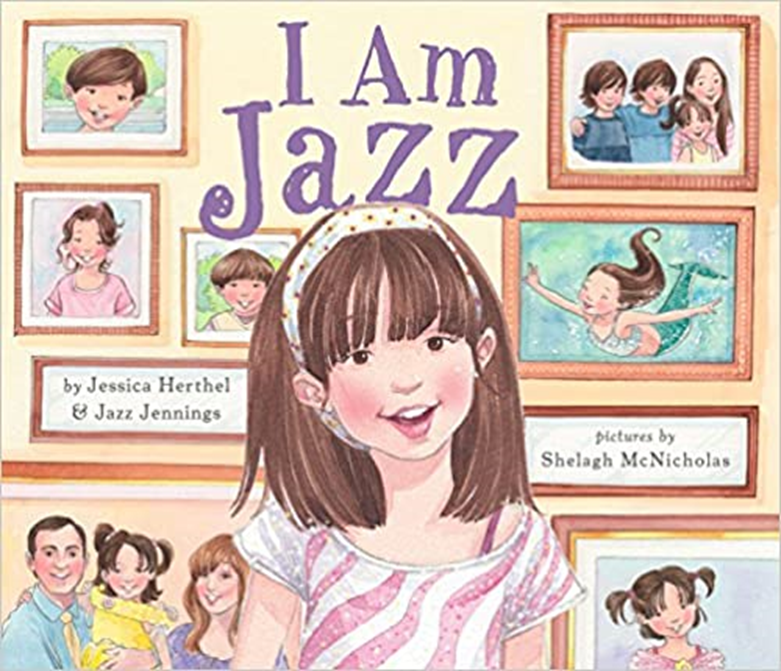
·  I Am Jazz by Jazz Jennings and Jessica Herthel


The story of a transgender child based on the real-life experience of Jazz Jennings, who has become a spokesperson for transkids everywhere

"This is an essential tool for parents and teachers to share with children whether those kids identify as trans or not. I wish I had had a book like this when I was a kid struggling with gender identity questions. I found it deeply moving in its simplicity and honesty."—Laverne Cox (who plays Sophia in “Orange Is the New Black”)

From the time she was two years old, Jazz knew that she had a girl's brain in a boy's body. She loved pink and dressing up as a mermaid and didn't feel like herself in boys' clothing. This confused her family, until they took her to a doctor who said that Jazz was transgender and that she was born that way. Jazz's story is based on her real-life experience and she tells it in a simple, clear way that will be appreciated by picture book readers, their parents, and teachers.


·  To Kill a Mockingbird by Harper Lee

 ·  It's Perfectly Normal by Robie H. Harris

With more than 1.5 million copies in print, It’s Perfectly Normal has been a trusted resource on sexuality for more than twenty-five years. Rigorously vetted by experts, this is the most ambitiously updated edition yet, featuring to-the-minute information and language accompanied by new and refreshed art.

"It's Perfectly Normal is informative and interesting; reassuring and responsible; warm and charming. I wish every child (and parent) could have a copy." — Penelope Leach, Ph.D., author of YOUR BABY & CHILD

"I recommend [IT'S PERFECTLY NORMAL] to parents and children who are coming into adolescence. They will love it." — T. Berry Brazelton, M.D. author of TOUCHPOINTS

"A perfectly wonderful treatment of the always touchy subject of sex education for young people. The book treats the subject seriously and its intended readers respectfully." — Hugh B. Price, president, National Urban League, Inc.

 ·  Bad Kitty (series) by Nick Bruel


From the creator of The New York Times bestseller Boing! comes the riotous story of a cat gone berserk -- four times over an in alphabetical order each time. Kitty is not happy hen she's told that her favorite foods are all gone and all that's left are Asparagus, Beets, Cauliflower, Dill...and 22 other equally unappealing vegetables. So she: Ate my homework, Bit grandma, Clawed the curtains, Damaged the dishes, and so on, through Z. Only when tastier things arrive (An Assortment of Anchovies, Buffalo Burritos, Chicken Cheesecake...) does she Apologize to Grandma.

 ·  Goosebumps (series) by R.L. Stine

Discover the original bone-chilling adventures that made Goosebumps one of the bestselling children's book series of all time!

Lindy names the ventriloquist's dummy she finds Slappy. Slappy is kind of ugly, but he's a lot of fun. Lindy's having a great time learning to make Slappy move and talk. But Kris is jealous of all the attention her sister is getting. It's no fair. Why does Lindy always have all the luck?Kris decides to get a dummy of her own. She'll show Kris. Then weird things begin to happen. Nasty things. Evil things. No way a dummy can be causing all the trouble. Or is there?Now with all-new bonus material revealing Slappy's secrets and more.

 ·  In Our Mothers' House by Patricia Polacco


Marmee, Meema, and the kids are just like any other family on the block. In their beautiful house, they cook dinner together, they laugh together, and they dance together. But some of the other families don?t accept them. They say they are different. How can a family have two moms and no dad? But Marmee and Meema?s house is full of love. And they teach their children that different doesn?t mean wrong. And no matter how many moms or dads they have, they are everything a family is meant to be.

Here is a true Polacco story of a family, living by their own rules, and the strength they gain by the love they feel.

 ·  The Catcher in the Rye by J. D. Salinger

Anyone who has read J.D. Salinger's New Yorker stories--particularly A Perfect Day for BananafishUncle Wiggily in ConnecticutThe Laughing Man, and For Esme With Love and Squalor--will not be surprised by the fact that his first novel is full of children. The hero-narrator of The Catcher in the Rye is an ancient child of sixteen, a native New Yorker named Holden Caulfield.


Through circumstances that tend to preclude adult, secondhand description, he leaves his prep school in Pennsylvania and goes underground in New York City for three days. The boy himself is at once too simple and too complex for us to make any final comment about him or his story. Perhaps the safest thing we can say about Holden is that he was born in the world not just strongly attracted to beauty but, almost, hopelessly impaled on it.

There are many voices in this novel: children's voices, adult voices, underground voices-but Holden's voice is the most eloquent of all. Transcending his own vernacular, yet remaining marvelously faithful to it, he issues a perfectly articulated cry of mixed pain and pleasure. However, like most lovers and clowns and poets of the higher orders, he keeps most of the pain to, and for, himself. The pleasure he gives away, or sets aside, with all his heart. It is there for the reader who can handle it to keep.

 ·  The Holy Bible

·  The Giver by Lois Lowry

In Lois Lowry’s Newbery Medal–winning classic, twelve-year-old Jonas lives in a seemingly ideal world. Not until he is given his life assignment as the Receiver does he begin to understand the dark secrets behind his fragile community.


The Giver, the 1994 Newbery Medal winner, has become one of the most influential novels of our time. The haunting story centers on twelve-year-old Jonas, who lives in a seemingly ideal, if colorless, world of conformity and contentment. Not until he is given his life assignment as the Receiver of Memory does he begin to understand the dark, complex secrets behind his fragile community. Lois Lowry has written three companion novels to The Giver, including Gathering Blue, Messenger, and Son.

 ·  Anne Frank: Diary of a Young Girl by Anne Frank

Discovered in the attic in which she spent the last years of her life, Anne Frank’s remarkable diary has since become a world classic—a powerful reminder of the horrors of war and an eloquent testament to the human spirit. 


In 1942, with Nazis occupying Holland, a thirteen-year-old Jewish girl and her family fled their home in Amsterdam and went into hiding. For the next two years, until their whereabouts were betrayed to the Gestapo, they and another family lived cloistered in the “Secret Annex” of an old office building. Cut off from the outside world, they faced hunger, boredom, the constant cruelties of living in confined quarters, and the ever-present threat of discovery and death. In her diary Anne Frank recorded vivid impressions of her experiences during this period. By turns thoughtful, moving, and amusing, her account offers a fascinating commentary on human courage and frailty and a compelling self-portrait of a sensitive and spirited young woman whose promise was tragically cut short.

Praise for The Diary of a Young Girl

“A truly remarkable book.”The New York Times

“One of the most moving personal documents to come out of World War II.”The Philadelphia Inquirer

“There may be no better way to commemorate the fiftieth anniversary of the end of World War II than to reread The Diary of a Young Girl, a testament to an indestructible nobility of spirit in the face of pure evil.”Chicago Tribune

“The single most compelling personal account of the Holocaust . . . remains astonishing and excruciating.”The New York Times Book Review


·  Draw Me a Star by Eric Carle


Draw me a star. And the artist drew a star. It was a good star. Draw me a sun, said the star. And the artist drew a sun. And on the artist draws, bringing the world to life picture by beautiful picture until he is spirited across the night sky by a star that shines on all he has made. In Draw Me a Star, Eric Carle celebrates the imagination in all of us with a beguiling story about a young artist who creates a world of light and possibility.


"A remarkable, quintessentially simple book encompassing Creation, creativity, and the cycle of life within the eternal." —Kirkus Reviews, pointer review

"This book will appeal to readers of all ages. An inspired book in every sense of the word." —School Library Journal

"
A fable about the passage through life and its fullness of possibilities, children will like the cumulative effects of the tale, the creation of the world through paints, and Carle's collages flaring with rainbow hues." —The Bulletin of the Center for Children's Books


·  1984 by George Orwell

Written more than 70 years ago, 1984 was George Orwell’s chilling prophecy about the future. And while 1984 has come and gone, his dystopian vision of a government that will do anything to control the narrative is timelier than ever...

• Nominated as one of America’s best-loved novels by PBS’s The Great American Read •

The Party told you to reject the evidence of your eyes and ears. It was their final, most essential command.

Winston Smith toes the Party line, rewriting history to satisfy the demands of the Ministry of Truth. With each lie he writes, Winston grows to hate the Party that seeks power for its own sake and persecutes those who dare to commit thoughtcrimes. But as he starts to think for himself, Winston can’t escape the fact that Big Brother is always watching...

A startling and haunting novel, 1984 creates an imaginary world that is completely convincing from start to finish. No one can deny the novel’s hold on the imaginations of whole generations, or the power of its admonitions—a power that seems to grow, not lessen, with the passage of time.


So. Do you seriously want to ban Captain Underpants? The Bible? Any book which admits that gay people exist? Anne Frank?

This is wrong. Please withdraw HB1944.


Thursday, December 30, 2021

How to Write a Book

This morning I had a Facebook notification that a friend had tagged me on a post of a friend of hers, which read in part, "Has anyone written a book before?! I need to know where to start. I have like 7-8pg." I realized my advice would be rather lengthy for a Facebook post, then I thought hey, I could do this as a blogpost. Pretty good topic.

First of all, the friend-of-a-friend appears to be an adult. I say that only because I'm often asked the exact same question by children, and my answers to children would be somewhat different. I'm against children seeking publication--they have no idea how hard it can be and they're up against adult professionals, both of which are also true of adults new to writing, but they're also still kids. They shouldn't be making something fun into work, not yet, and they're often being pushed to make "real books" by the adults in their lives. You don't expect Little Leaguers to play for the Braves. Quit expecting the equivalent from young writers.

Now. Said FOF is an adult woman, knows very little about publishing. Is inspired to write. GREAT. She's got everything she needs: a story and the ability to learn. Because publishing is a business. It helps very much if you think of it like performing onstage: those actors in Hamilton are making bank, because that show is amazing, they're incredibly talented, and they've worked very, very hard for a very long time. You, too, could work that hard. Whether you're that talented is your own business--but--I'm loving this analogy here--there are lots of parts of writing, like performing onstage, that can be learned. Some people are total naturals, complete freaks of nature. Most, even the very successful ones, aren't. I'll say it here: Lin Manuel Miranda's natural voice, while good, isn't on par with most Broadway musical stars. But he's learned enough and worked enough and is good enough at other things that it all works out pretty well.

But just as there's Broadway, so too is there off-Broadway. Regional theaters. Local amateur productions. You don't have to streak straight to the top of the bestseller lists, and, in fact, you aren't likely to. That's fine.

Back to writing. Let's start with a few questions. One: who is your story for? Children? If so, which children? Toddlers being read to? First graders starting to read on their own? Sixteen-year-olds? Those are all very different. If it's for adults, that's not a monolithic audience either. Fiction? Nonfiction? Poetry? Memoir? Different rules. (I'm going to go ahead and assume you're not writing for an academic audience--that's another branch entirely.) Then think about genre: historical fiction, romance, mystery, fantasy, etc. If you're not sure, that's okay, just start thinking about it.

Here's another primary question. What is your ultimate aim? There's a wide difference between wanting to write up some family stories to pass down to the next generation and wanting to become the next Stephen King. Publishing right now can be divided into two types: traditional and self-published. When you write for a traditional publisher, as I do, you submit a manuscript to the publisher. They decide whether or not they want to publish it. (I'm simplifying here a bit.) They assign you an editor, and you and the editor revise the manuscript until everyone is happy with the result. (If you're happy and they aren't, tough noogies. Back to work.) Then they have in-house staff design the layout, cover, trim size. They put your book into their marketing plan, their salespeople pitch it to bookstores and distributors, standard reviewing journals (Publisher's Weekly, Library Journal, etc.) review it, and it gets sold in bookstores nationwide without the author having to do very much. The author is paid an advance on royalties and then a certain percentage of the price of all the books sold. You never have to pay back the advance even if your book tanks, but an advance for beginning writers will be in the low thousands of dollars, not necessarily a lot--but if your book sells well, you'll get more.

When you self-publish, you, the author, bear the cost of producing the book. You will likely pay for an editor to review your work and suggest edits, but if you don't want to do the edits that's up to you. You'll either pay someone else or you yourself will supervise the design and select the cover. You'll direct the marketing. You'll pay upfront for your book to be physically produced. You'll be responsible for trying to get it into bookstores, and this will likely be difficult to do. You can pay some journals to review your book, but not all of them, and you do have to pay them. On the other hand, you get complete control of your product, and you get a higher percentage of the book's price as profit. You might pay $3 per copy to create your book but sell it for $15--$12 profit per copy, instead of the $1.50 per copy profit you'll make traditionally publishing. On the other hand, better distribution means you're much more likely to sell lots of copies through traditional publishing. With self-publishing you take the risk. It's worth understanding that most people who self-publish do not sell enough copies of their book to make any profit at all. Most are out money. On the other hand, I have personal friends who have done very well for themselves through self-publishing: they understand their market and are very good at that end of the business, as well as being good writers.

Here's the other thing: self-publishing is akin to amateur theatrics, in that anyone can do it. Some people are going to be very talented, and work very hard, but a lot of people are just dabbling. That's fine. There's plenty of room for dabblers. But it you want to be traditionally published, you're going to have to think of that more as Broadway--there are a lot of people trying to get onstage, and they don't reserve spots for newbies. You'll have to audition and prove yourself.

(This is also why the person who suggested you write to publishers and ask for advice is off base: because it's the equivalent of asking Lin Manuel Miranda how to get started in theatre. It's not that he doesn't know or isn't a nice guy, he just doesn't have time to send you an answer.)

So. This is a lot of words, and I still haven't given you any advice. So here it is: take some time and do your research. You don't have to stop writing while you do that. Write whatever you like, enjoy yourself, and at the same time, start learning. Read a lot of books in your genre. Develop a feel for the structure, characters, general rules. At the same time, start learning about the business side. Go to the library and get the current Writer's Market. There's one published every year, and most libraries have them. (There's a separate one for writing for children.) Read it. Read Stephen King's book On Writing. Practice. Learn to revise. Think about your craft. Take yourself seriously, while still having fun. If you're writing for kids, there's an organization called the Society of Chidren's Book Writers and Illustrators that runs conferences and has lots of good information online. There are organizations for writers for adults, too, though I don't know them by name.

Join a writer's group, if you can. Learn to have your work critiqued, and to offer critiques. Practice. Finish a story, even if halfway through you think it's crap (and it probably is.). You'll learn things by writing a story all the way to the end that you can't learn otherwise. 

Understand that there are very, very few overnight successes in this world. There are a few, and some of them are even nice people, but most of us have to work at our craft for a long time. It took me nine years of writing for horse magazines and doing random bits of journalism and working my way up to remote editing and writing work-for-hire before my first novel was published. It took me 9 drafts to get my penultimate book right--and that was my 17th (traditionally) published book. It's a lot of work no matter how talented you are.

Also? It's worth it. Start now.


Thursday, December 16, 2021

Fourteen lovely minutes

So the last two days, though mostly fine, have been marred by a few pieces of genuine bad news. One isn't mine enough to share publicly. Another is that T, the horse I rented for nine months until last spring, died a few days ago. He was living happily and well at the farm he went to after mine, and he died of one of those stupid things that sometimes affect horses and can't be made right quickly enough to save them. 

I miss T's sweet spirit. I miss his sense of genuine good. I'm grateful for the time we had together.

I hadn't been planning on riding today. I've got an appliance repairment whose arrival was originally scheduled as "between 8 and 5" and my husband's partners and their spouses are coming for dinner tonight. Thankfully, the broken appliance is not required to cook the dinner, and all the guests are bringing a dish. I spent some time this morning ironing my good napkins, very grateful that, unlike last year, I had a reason to use them this year--which is probably the only time I've ever been grateful to be ironing--and then the appliance people texted that they were narrowing their arrival time to "between 4:41 and 6:11" or, in other words, "perfectly arranged to screw up your dinner, but hey, now you can leave the house."

So I did. I went to ALI World Headquarters to fill one last order that came in before the schools shut for break, and then I grabbed lunch with my husband, and then, while we were in the middle of eating, the other bad news showed up and put a damper on everything. So after lunch I scoffed at my housework and went to the barn.

I'd have to go to the barn anyhow, of course, to feed things. The cats milled around, frantic, having not eaten since they scammed an extra meal yesterday. The horses looked peeved. Yesterday, when I went to feed, I found their water trough entirely empty, and it was clear from the reproachful way that they guzzled once I'd filled it that they blamed me entirely. Which was outrageous, since one of them--and Sarah, I think we all know it was you--had knocked the halfway full trough off the blocks it sits on precisely so that Sarah can't dump it over, dumped it over, flung the water heater halfway down the field, then stomped about in the mud puddle they'd created. In short, not at all my fault.

I put them in, then zipped my riding boots over the yoga pants I was wearing--close enough to breeches if you're not doing much. Fetched Rosie from her stall. Rosie's the little mare I bought last July. We went out to my small sand arena, and Rosie, I was pleased to see, let out a little sigh of happiness. The small arena is for flatwork, dressage; historically, neither me nor any horse I ride has enjoyed dressage. But Rosie and I are starting to get the hang of it. Rosie loves it when I ride well and hates it when I ride poorly. She doesn't buck or kick or doing anything awful, but she puts back her ears, gnashes her teeth, and stiffens her whole body whenever I do something wrong. Sometimes I'm not sure what I've done wrong, but with Rosie's immediate feedback I know I've screwed up something. For awhile I was dropping my inside shoulder on upward canter transitions. Lately I've fixed that, but been putting my outside leg too far back at the trot while using my inside leg to make her round. She starts to transition to canter, realizes I'm not actually asking her to, just flailing incoherently, and goes back to the trot pissed off about it. Rosie has a smart forward walk--unless I tighten my seat, in which case she slows and stiffens and glares at me. You see how it goes.

As a result our flatwork sessions have become amazingly zen. I need to be fluid and balanced and precise with my body; I need to be focused yet relaxed, clear but soft in my aids. And Rosie rounds herself into my hands, and we dance--sometimes for as many as six or seven strides before I tighten somewhere and screw us up again. And then we take a deep breath, and try again.

I time my rides on the exercise app on my watch. Today Rosie and I were right more than we were wrong. We found harmony. She practically purred.

At times like that it's tempting to just keep going, to push yourself and your horse and see what else you can achieve. Lateral work? Perfect downward transitions?

Not today. I needed some good news, and Rosie gave it to me. I patted her and called it quits, and when I dismounted saw that I'd been riding for exactly fourteen minutes.

Sometimes that's long enough.

Wednesday, December 1, 2021

How It's Going With the Books

 No, not the ones I write. They're going fine, fine-ish, anyhow, after a somewhat difficult quarantine year. (All the writers I know had some degree of a difficult quarantine year.) I have a completed draft of a novel sitting in my editor's hands: she was supposed to get back to me about it three weeks ago, and hasn't, and now it's December 1. Publishing absolutely entirely shuts down for two weeks leading up to the New Year--they lock the offices, everyone goes home--of course, this year they might already be home--but in truth they mostly shut down as soon as Thanksgiving rolls around. I won't likely hear anything until January. Years ago this used to frustrate me, but now I just embrace the holiday spirit. Why not? I can't change it so I might as well enjoy.

I am working on the start of a new book, but it's too new to talk about yet.

Today I'm going to talk about the books from Appalachian Literacy Initiative. Phew. We're nearly halfway into our fourth year of operation. (We follow the school calendar.) We've grown so much and we're doing so well, and there's so much more to be done. I know I've talked in this space quite a lot about how important it is that kids have access to books. Today I'm going to talk nuts and bolts.

This year we were graciously granted permanent office space in a building owned by another local nonprofit. It's a largish room, and we've filled it with industrial book shelves (bought cheap at Sam's Club, they hold several hundred pounds per shelf, which is good because we need them to). When you walk in the door, there's a shelf immediately to your left, where until yesterday UPS put unopened boxes of books that we'd ordered. (We had a stack of boxes obscured the door, so we've changed plans.) After that, running clockwise around the outside of the room, two desks crammed beneath the one window. One desk has some office supplies on top, the other holds our laptop and printer. The office supply desk is used for all sorts of things. The printer desk is the order and shipping hub.

Now we're on the wall across from the door. Four sets of bookshelves. The first set is office supplies--paper, stickers, tape, folders--some boxes of books we've set aside for various reasons, including ones that arrive damaged, and, on the top shelves, some YA books we were donated that we haven't yet found homes for. 

The next three sets of shelves are the third-grade choices for this school year. Twenty-four books, and each gets half a shelf. We put stickers inside all of the books we give away: they say Appalachian Literacy Initiative and have a space for the child to put their name. That way, when 14 kids in the same class get the same title, they can tell the books apart. We also have stickers for some of the organizations that have sponsored entire schools: "A Gift from Ballad Health." "A Gift from the Bill Gatton Foundation."

Now. The number of copies of each book that can fit in the designated space depends entirely upon the size of the books. All books are different. Alien Ocean Animals is probably our smallest, space-wise; Magnus Chase, in hardcover, is the largest. We don't put any books on the grade shelves until they're properly stickered. Sometimes we store extra boxes of stickered books on the tip-top shelves. 

Turn the corner, and the next wall is fourth grade. Turn it again, and the shelves for the fifth grade books fit neatly along the wall with the door. 

In the center of the room, three more sets of bookshelves, crammed together, and two more work tables for packing books. The shelves are full--crammed full--of extra books, ones that aren't part of the lists for the three grades we're doing this year. Sometimes that's because we couldn't get enough copies or a title even if we wanted to. Sometimes these books are donations direct from writers or publishers. When we order through Scholastic's nonprofit arm, Scholastic Literacy Partnerships, they send us boxes of random free books, and we put those on these shelves as well. If the local teachers enrolled in our program come to pick their books up, instead of having us mail them, we let them pick out a couple of extra books for their classrooms. We also give them out to different community organizations--a hundred earlier this fall for a local after-school group in a federal housing project, a couple hundred to Girls Inc, a couple hundred soon to be sent to a school system's holiday gift program.

In all the corners of the room we've stuffed flattened cardboard boxes. Books come out of the boxes, we save the boxes, we put books back into the boxes and we ship them out.

This year Tuesdays are our big ship-out days. We welcome any and all volunteers any and all Tuesday afternoons. If you'd like to come by, please do: at the very least there are always books to sticker. 

We ship our teachers sets of six titles four times a year.  We sent the second teacher sets a few weeks ago--six books each to 185 teachers. It was a helluva day. They first teacher sets we shipped out over several weeks, because we got some last-minute funding that allowed us to add several additional schools. That was fabulous but has also created chaos, as it meant we no longer had enough books for the year. 

We get our books cheaply through First Book, Scholastic Literacy Partners, and publisher donations (big shouts out to Thorndike and Penguin Random House). This means that the money people donate goes a lot farther than it otherwise would, but it also means we have to stay on top of our game. A title available last week might not be available again for six months, or ever.  Last summer I'd figured we needed at least 200 copies of any one title to have it in our program, but that was a serious underestimation. We ended up enrolling 1200 students per grade. Each student picks one book from every set of six. That would suggest that 200 copies might be just enough--except that the teachers get classroom sets. We need 60 to 65 copies of each title, depending on the grade, just for the classroom sets. Also we are very firm about kids getting to choose whichever books they want--and we can't always predict which titles will be popular. We're realizing that 275 is the absolute minimum for any title this year--we'll need 350 or more for many. That's fun math to be doing in December--and I mean that absolutely. We are DELIGHTED to be in this position. We are loving giving away this many books. It's the best damn thing in the world.

So yesterday: I showed up at what I love to call World Headquarters early, because the local news channel wanted to interview me. (The resulting spot turned out ghastly, with the anchor mangling ALI's name and it all going downhill from there--what possessed me to wear that shirt?--so no link, thank you.) UPS delivered some books shortly afterward: "Hi, Ma'am, just add them to the pile?" It was a huge pile, causing problems. Happily we've just been given a bit more space in the back of the building, and when a couple of college kids showed up (we give out official volunteer hours!) the first thing I had them do was move all the unopened boxes of books out of the main room. Then they stickered some of the free Scholastic books, since we'll be giving those away next week. I sat down at the computer and started printing out student orders from our teachers. The other board members grabbed the order sheets, and started packing boxes.

We had at least a dozen orders. Some were for one class, some for an entire school. Here's a sample, from one of our largest enrolled schools:

Fifth grade: Best Friends 12; The Crossover 3; The Girl Who Drank the Moon 1; The Player King 4; 100 Things to Be 11; Be Prepared 42; Black Panther 34; Flora & Ulyssess 4; From the Desk of Zoe Washington 16; The War I Finally Won 5. 

You'll notice that it's more than six titles. That's because students are always allowed to order from previous lists.

What I noticed: Be Prepared 42. Shoot.

Be Prepared is a graphic novel. It's funny, and quirky, and I love it. I scored 200 hardcover copies last summer at an unbelievable discount, something like $1 for a $23 book. A few weeks ago I managed to get another 40 copies, in paperback, through First Book, but that was all they had. I bought them out. They'll get more eventually, probably, but it could take months.

I didn't think this would be a problem. Be Prepared really is quirky. It's not nearly as well known as some of the other graphic novels on our list. 

I was wrong. We started filling orders, and it was clear that Be Prepared was in high demand. I started the day with 175 copies and ended the day with 20, and we hadn't filled all the orders that had come in, and there are still a bunch more orders to come.

Anyhow, I want to tell you about the process: it's this. We take the printed order, take the books off the shelves, find a box or boxes to put them in. We tape the box, weigh it, print postage, copy the postage label onto a copy of the order form, so we know we've filled it, put the postage on the box, stack the boxes in the lobby of the building for the postman. Check off the schools/grades on our master list. Subtract the copies from our inventory.

We did that all afternoon. This morning I sat at my home computer with the inventory list and spent a moment being very very grateful for donations we've recently received. Then I went on First Book. First I looked for Be Prepared. I'd looked for it the day before, as soon as I saw we didn't have enough, and it wasn't in stock, but sometimes restocking miracles happen. Nope. Then I scanned the rest of the graphic novels for sale. It's a tough time of year, they're out of everything. Got 14 copies of Pea, Bee, & Jay when I'd have happily bought 150. ($3.50 for a $7.99 retail price). Went on to get 100 copies of Ghose ($3.75 each), 75 of Animal Smackdown--a real victory, that, as we've given out 363 copies so far this year. The price has gone up, from $4.95 a copy to $5.85, but this is a glossy full-color book with a retail price of $14.99. I got one lonely copy of The One and Only Ivan, 18 of Power Forward, 96 of Unusual Chickens for the Exceptional Poultry Farmer ($3.25/copy). I looked at the Book Bank, where the huge bargains are--it's there I got the hardcover Be Prepareds, back last summer. Bought one carton of Percy Jackson's Demigod Collection, 12 books for a total of $8.40. It might be brilliant but it might be too bulky to ship, hard to tell so we'll try a few first. Ghetto Cowboy, another favorite 120 copies. One copy of Hello Universe. I look in vain for Front Desk, which I've been trying to get more of for months, along with Guinness Animal Records, How to Steal a Dog, and Love That Dog. Love That Dog is particularly worrisome--we're running out. Oooh--the new Diary of a Wimpy Kid, #16! Three hundred copies. That, along with the 200 copies we have on hand of #15, should get us through the school year. 

I log into Scholastic Literary Partnerships, and am overjoyed to find both Narwhal and Jelly ($3.96, rp $8.99) and Love That Dog ($4.53, rp $7.99). I buy 100 copies of each. They've got Captain Underpants ($3.41, rp $5.99) back in stock, so I grab 100 of that and 100 of I Survived the Sinking of the Titanic. ($1.50, rp $4.95) This order qualifies us for 160 additional free books--I can't chose the titles, but I choose the age ranges. It'll be enough to ensure we have plenty for the school Christmas program. 

This does not solve my Be Prepared problem. We have new orders in and we can't fill them. We can buy the book through an independent bookstore, which will give us a hefty discount (though not as good as FB or SLP), but shipping comes direct from the publisher and will take a few weeks. I don't have an in with the publisher, First Second--I've been known to beg unashamedly from publishers where I do. 

Sighing, I go on Amazon. I can get the paperback of Be Prepared (rp $14.99) for $10.49, which is steep, but I'm desperate. 

Amazon will only let me buy 30 copies. I don't know why, they've got quotas now of most titles. I once bought 80 copies of How to Steal a Dog from them, and now I can't buy anymore ever. I buy 30 copies, then call one of the other board members and have her buy 30 copies from her home computer too. It's not enough, but it'll buy us a bit of time.


This. This is why we do it. Just look at her. She's holding the first book she ordered. This child attends the school that ordered 42 copies of Be Prepared. We intend to see that they get them.

We've got a fundraiser going on Facebook right now, which I'm going to link to this exceptionally long post. You can also donate to us via our website, or by mail to PO Box 3283, Bristol, TN 37625. xoxox